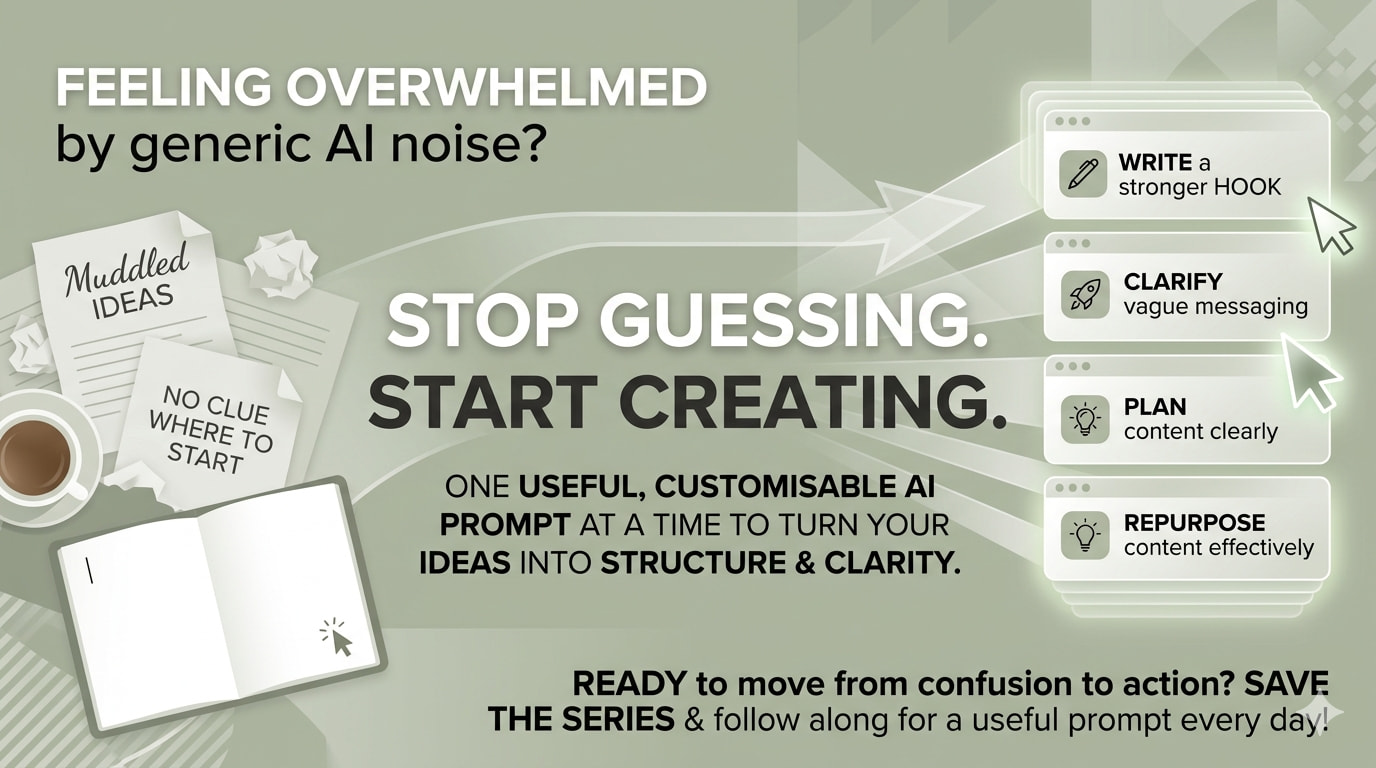
Why I’m starting a new series of useful AI prompts for writers, creators, and small business owners
Why I Wanted to Start This
The more time I spend around AI content, the more I notice the same problem.
There are prompts everywhere, but not nearly enough that feel genuinely useful.
There are endless lists, giant bundles, and flashy collections promising hundreds of ideas, but so much of it feels vague, repetitive, or disconnected from the kind of work people are actually trying to do. It is very easy to collect prompts. It is much harder to find ones that help with a real problem on a real Tuesday afternoon when your draft is a mess, your plan is unclear, or your brain feels like a browser with thirty tabs open.
That is why I wanted to create this series.
I did not want to make another giant list of prompts people might bookmark and never use. I wanted to build something simpler, more practical, and easier to return to.
The Idea Behind the Series
A Prompt a Day Keeps the Guesswork Away is exactly what it sounds like.
It is a series built around one useful prompt at a time.
Each post will focus on a specific task or sticking point, whether that is turning a vague idea into a blog post, writing a stronger hook, cleaning up clunky wording, planning content more clearly, or figuring out what your audience may actually need from you.
The goal is not to overwhelm people with volume. It is to offer one helpful tool at a time, with enough explanation to make it usable.
That part matters to me.
I think prompts are most valuable when they are connected to a purpose. Not just “here is a clever thing to type into AI,” but “here is a prompt that helps you solve this problem, and here is how to adapt it to your own work.”
Who Am I Writing This For?
I’m writing this for people who are trying to make useful things and do better work.
Writers who need help shaping rough thoughts into something clearer.
Creators who want to repurpose content without flattening their voice.
Freelancers and small business owners who need stronger messaging, better content ideas, clearer offers, and more structure around what they are building.
And also, honestly, for people who are a little tired of the noise around AI.
There is so much performance around these tools. Some people talk about them as if they are magic. Others talk about them as if using them means giving up your brain. Most of the time, neither view is especially helpful.
What interests me more is the middle ground.
The practical use.
The thoughtful use.
The kind of use that helps you get unstuck, think more clearly, or make something better.
What I Want This Series to Deliver
What I want this series to deliver is simple.
Less guesswork.
Less staring at a blank page, wondering where to start.
Less fumbling through scattered ideas, awkward drafts, weak calls to action, or vague content plans that never quite become anything.
More clarity.
More momentum.
More prompts that actually earn their place by helping you move from confusion to action.
Some of the prompts in this series will be about writing. Some will be about editing, planning, business ideas, content strategy, audience insight, or making decisions. But all of them will be rooted in usefulness.
That is the standard I want to keep coming back to.
Not impressive for five seconds.
Useful in real life.
What This Series Is Not
This is not about handing over all your thinking to AI.
It is not about flooding the internet with more generic content.
It is not about pretending every prompt is a breakthrough.
I do not think the best use of AI is to replace judgment, originality, or care. I think the better use is support. Structure. Perspective. Speed, sometimes. Clarity, often.
A good prompt can help you move faster, but it can also help you ask a better question. It can help you spot what is missing, find the strongest angle in a messy idea, or create a cleaner path through work that feels muddled.
That is the kind of value I’m interested in.
What You Can Expect in Each Post
Each post in this series will include one prompt built around a clear use case.
I’ll explain what it helps with, why it works, and how you can customise it depending on your project, audience, or goals. In many cases, I’ll also include examples, because a prompt is always more useful when you can see how it works in context.
I want these posts to feel practical and easy to follow.
Not overcomplicated.
Not dressed up in inflated language.
Just clear, usable help.
Why I Think This Matters
I think a lot of people do not need more ideas.
They need better ways to shape the ideas they already have.
They need help turning rough thoughts into structure. Turning clutter into decisions. Turning effort into something more focused and effective.
That is why I think a series like this can be genuinely useful.
Not because prompts are exciting in themselves, but because the right prompt, used at the right moment, can remove friction. It can help you get moving again. It can save time, sharpen your thinking, or make your next step more obvious.
That may not sound dramatic, but it is often what actually helps.
What I Hope You’ll End Up With
By the end of this series, I hope you will have a growing library of prompts you can actually return to.
Prompts for writing, planning, editing, refining, researching, and making better decisions.
Not a random pile of digital clutter.
A set of tools you understand, can adapt, and can use in your own work.
That is what I want this to become.
Something practical.
Something grounded.
Something that makes the work feel a little clearer and a little less overwhelming.
Where We’re Beginning
So that is where I’m starting.
One prompt a day. One clear use case. One less piece of guesswork in the middle of everything you are trying to make, write, or figure out.
The first post in the series will focus on a prompt for turning a vague idea into a clear blog post, which feels like the right place to begin.
Because most good work does not begin with certainty.
It begins with a rough idea, an instinct, a note, a question, or a sentence that might become something if you stay with it long enough.
Sometimes you do not need more input.
You need a better way to shape what is already there.
That is what this series is here to help with.
Are you ready to start?