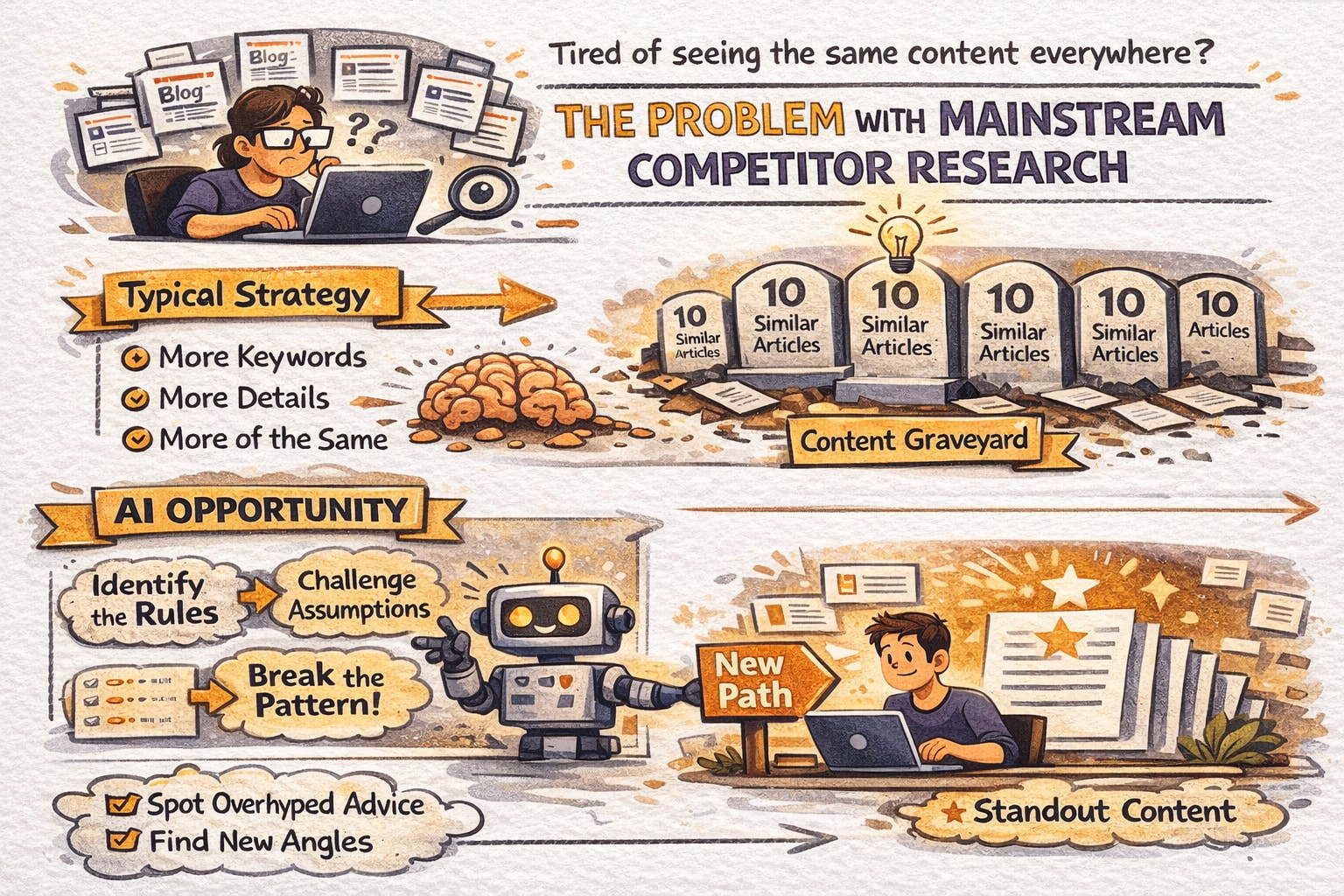
So, if you’ve ever opened a competitor’s blog post, scrolled for five seconds, and thought, “I hate this, but I guess I have to do it”… welcome. You’re among friends.
Today, we’re discussing competitor research, and yes, we’re utilizing AI. But not in the usual “how to steal ideas with a robot” way. More in the “how to stop writing the same content as everyone else and still rank” way.
Because mainstream competitor research has one big flaw: it quietly trains you to become a better version of the same thing.
And that’s not a strategy. That’s a slow-motion identity crisis.
Let’s set the scene.
You’re trying to outrank someone. You open their page. It’s… fine. Helpful. Polished. It has the same intro, the same steps, the same “here are some tips,” and the same ending that gently pushes you into their course.
You keep reading, because you’re looking for gaps… angles… anything you can use.
But after a few pages, your brain starts melting. Everything sounds the same.
That is the moment AI becomes useful.
Not to help you copy faster.
To help you see the pattern you’re trapped in.
THE REAL PROBLEM WITH “OUTRANKING”
The mainstream approach goes like this:
“Read what’s ranking. Do the same thing… but better. More detailed. More keywords. More sections.”
Sometimes that works.
But it also creates a particular kind of content graveyard. You know it when you see it. Ten articles saying the same thing, in slightly different fonts.
AI can do better than that if you use it correctly.
Instead of asking AI to help you mimic the page, you ask it to map the “genre rules” of your niche.
Because most competitor content is not original. It’s a template with a slightly different face.
And if you can see the template… You can step outside it.
THE SETUP STORY (PINTEREST AFFILIATE EXAMPLE)
Let’s use a real example.
Imagine you’re in affiliate marketing.
Your competitor has a post titled:
“How to Make Money with Affiliate Links on Pinterest.”
You paste their content into ChatGPT, and you prompt:
“Analyze this competitor blog post. Give me a summary of the main points, the tone, the structure, and what type of reader they’re targeting. Also, tell me which keywords they’re likely going after and any obvious SEO gaps or missed content opportunities.”
AI comes back with something like:
-
Main points: build niche boards, use rich pins, don’t cloak links, and track clicks.
-
Tone: beginner-friendly, slightly formal.
-
Structure: intro with benefits, step-by-step, one example, course CTA.
-
Reader: cautious beginners who don’t want to get banned.
-
Keywords: Pinterest affiliate marketing, make money with Pinterest.
-
Missed opportunities: no templates, no network comparisons, no legal guidance links.
And on paper, that’s incredibly useful.
Because now you’re not guessing. You’ve got the map.
But here’s the twist: the map is not the strategy.
THE UNCONVENTIONAL MOVE (FIND THE ASSUMPTION)
Most people stop at “missed opportunities.”
They go, “Perfect. I’ll fill those gaps and write a better article.”
That’s fine. That’s safe. That’s also what everyone else is doing.
So here’s the unconventional move.
Instead of asking “what did they miss?”
Ask: “What assumption are they selling?”
Most competitor content is built on one silent belief that never gets questioned.
In this case, the assumption might be:
“This is mostly a tactics problem. If you follow the steps, the money follows.”
But what if that’s not true for beginners?
What if the real problem isn’t tactics… Is it decision overload?
Too many tools, too many offers, too many pin styles, too many strategies. So they do nothing, or they quit.
That gives you a totally different angle.
Not “more steps.”
Fewer choices. Faster proof. A clearer path.
That’s how you create something competitors can’t easily replicate, because they’re stuck writing “the standard guide.”
HOW TO PROMPT AI FOR ANGLES PEOPLE ACTUALLY WANT
So yes, you can still ask AI for angles:
“Using that analysis, suggest 3 unique angles I could use to write a better blog post on the same topic.”
You’ll get sensible options like:
-
“How to Write High-Converting Affiliate Pins (With Templates)”
-
“Best Affiliate Networks for Pinterest Marketers”
-
“Avoid These Legal Mistakes…”
Good. Practical. A bit predictable.
Now add the prompt that changes everything:
“What is the most common advice in these posts that is probably overstated, missing context, or partly wrong? Suggest 3 contrarian angles that are still genuinely helpful, not clickbait.”
Now you get angles like:
-
“Stop Making New Pins: Build One Pin That Converts First”
-
“Pinterest Affiliate Marketing Isn’t Passive Until You Remove These 3 Choices”
-
“The Real Risk Isn’t Getting Banned. It’s Picking an Offer Nobody Wants”
That’s not just “better content.”
That’s a better mental model for the reader.
And mental models are what people remember.
GO DEEPER WITHOUT GOING LONGER
One of the best things you can do is stop trying to win by word count.
You do not need to write the longest article.
You need to write the clearest one.
So ask AI:
“Rewrite this outline to reduce cognitive load. Remove anything optional, add one fast-start path, and include a tiny win the reader can complete in 20 minutes.”
That last bit matters.
A “tiny win” turns your content into an experience, not just information.
People don’t share articles because they are long.
They share them because they worked.
IF IT’S A SALES PAGE, DON’T TURN THE HYPE UP
Now, if the competitor page is a sales page, you can prompt:
“Analyze this sales page. Break down the structure, emotional triggers, offer positioning, and credibility boosters. What’s their main hook? What objections do they handle or skip? Where could this page be improved to convert better?”
You’ll see things like:
-
Hook is simple but not urgent
-
Emotional triggers are the usual: escape the 9–5, money while you sleep
-
Credibility is thin: one testimonial, no data
-
Missing conversion elements: FAQ, guarantee, urgency
Mainstream advice says: add urgency, add more testimonials, push harder.
But here’s the unconventional approach:
Lower the fantasy. Raise the specifics.
Hype is cheap now. Everyone has it. It’s background noise.
Specificity is persuasive.
So ask AI:
“Rewrite this sales page with clearer benefits and stronger objection handling. Keep the tone similar, but reduce hype, increase specifics, and clearly say who it is not for.”
That “who it’s not for” section is terrifying for marketers and incredibly comforting for buyers.
It signals honesty.
And honesty converts.
MULTIPLE COMPETITORS (HOW TO STOP WRITING THE SAME POST)
If you’re looking at multiple competitor posts, prompt:
“Here are summaries of three competitor blog posts on the same topic. Compare them and list the most common content elements, then suggest one fresh angle that none of them covered.”
That’s great for finding the obvious opening.
But here’s the next-level prompt:
“What would I write if I wanted to be the only page someone needed on this topic? Suggest a structure that replaces five other articles, not competes with them.”
That’s how you create “the bookmark post.”
The one people send to friends.
The one that gets referenced.
Not because it’s longer.
Because it’s complete in the right way.
YOUR CHALLENGE
Here’s your challenge.
Find one blog post from a top competitor. Copy it into ChatGPT and ask:
“Analyze this competitor’s post for structure, tone, audience, SEO focus, and missed opportunities. Then suggest 3 angles I could use to write a better version.”
Then do the unconventional step:
Ask:
“What assumption is this post built on, and what is a more useful truth for the reader?”
Pick one angle.
Then prompt AI:
“Build me an outline that reduces fluff, increases specificity, and includes a quick win the reader can complete today.”
Write that version.
Because the goal isn’t to join the crowd with a slightly shinier article.
It’s to change the conversation so competitors have to follow you.
If this helped, save it and send it to someone who’s currently writing “the longer version” of a competitor post and quietly suffering. We’ve all been there. 
