So, quick question. Have you ever promoted something you genuinely believed in… and still watched people hover on the checkout page like it’s a haunted house?
They click. They read. They scroll. They almost buy. Then… nothing.
And you’re left staring at your screen, thinking, “What do you want from me? A handwritten apology?”
Today we’re talking about a fix that’s simple, effective, and weirdly underused: bonus bundles.
Not the fake kind. Not “here’s a random PDF called Mindset Secrets.”
I mean bonuses that make the main product easier to use, faster to apply, and way more tempting to say yes to.
And the best part? You can build them with AI in one focused session.
Let me tell you a quick story.
A while back, I watched two marketers promote basically the same type of offer. Same niche. Similar audience size. Similar vibe.
One of them did the classic approach: “Here’s the product. Here’s why it’s great. Here’s the link.”
The other one did something different.
They added a bonus bundle. Three tiny resources. Nothing fancy. No big course. No 47-module mega-bonus.
Just three pieces designed to remove friction.
And that second promo converted noticeably better. Not because the product suddenly got better.
Because the decision got easier.
That’s what a good bonus bundle does. It reduces hesitation.
So let’s break down how to build one that actually works.
First, what does the research say, in normal human language?
Scarcity and urgency can work, but only when they’re real and not manipulative. People respond to time limits and limited access. That’s not new. It’s just how brains behave when decisions feel “now or never.”
But here’s the important part: urgency works best when the offer feels genuinely valuable.
Not when you’re shouting “LAST CHANCE” like a carnival barker.
Bonus bundles increase perceived value without discounting. That matters because discounts train people to wait. Bonuses train people to trust.
And AI? Studies in knowledge work keep showing that generative AI can speed up drafting and help people produce stronger first versions faster, especially for writing tasks. The keyword is “first versions.” You still steer it. You still edit it. But the time savings are real.
So we use AI to create bonuses that are:
-
helpful
-
specific
-
fast to produce
-
directly connected to the main offer
Now let’s build one.
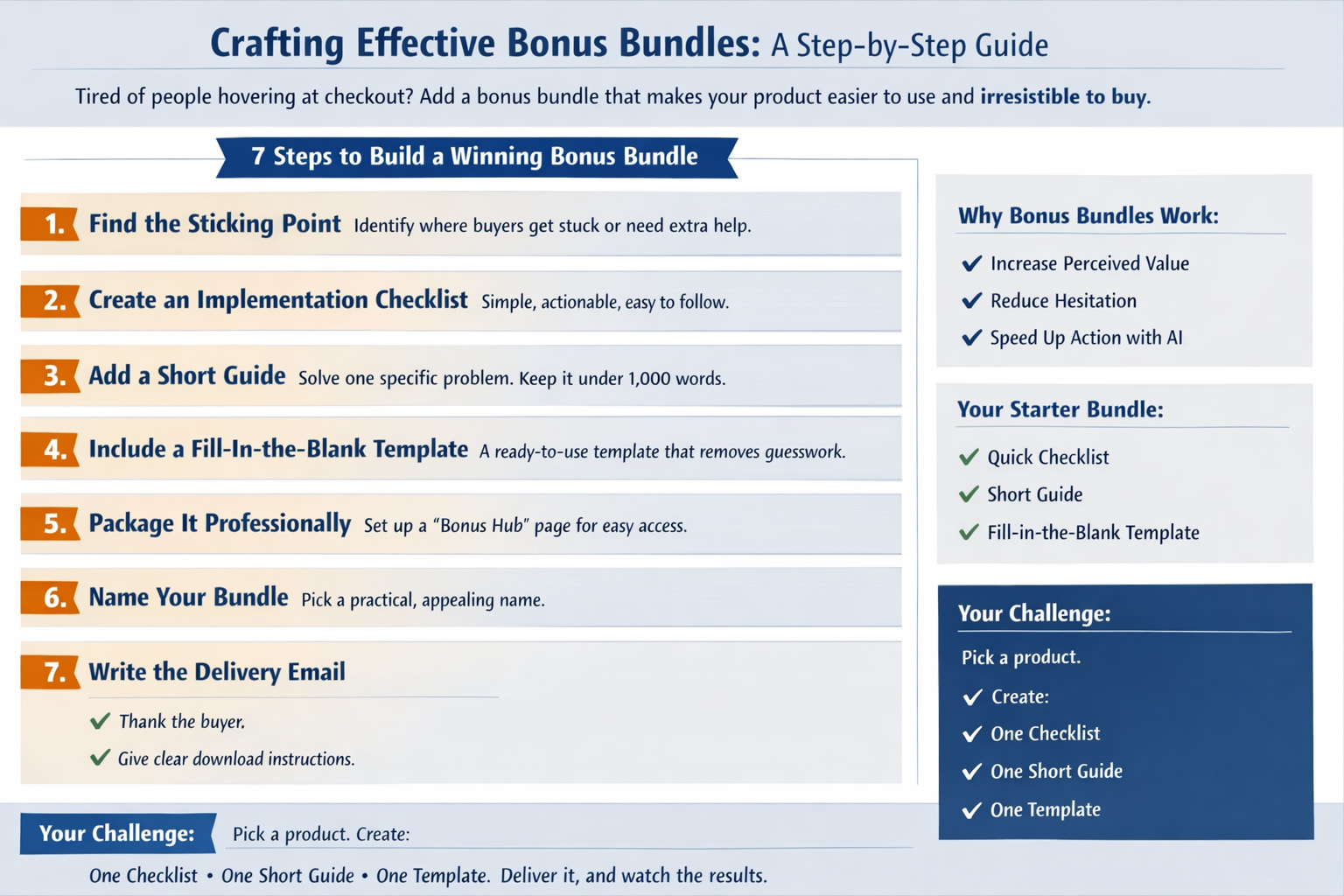
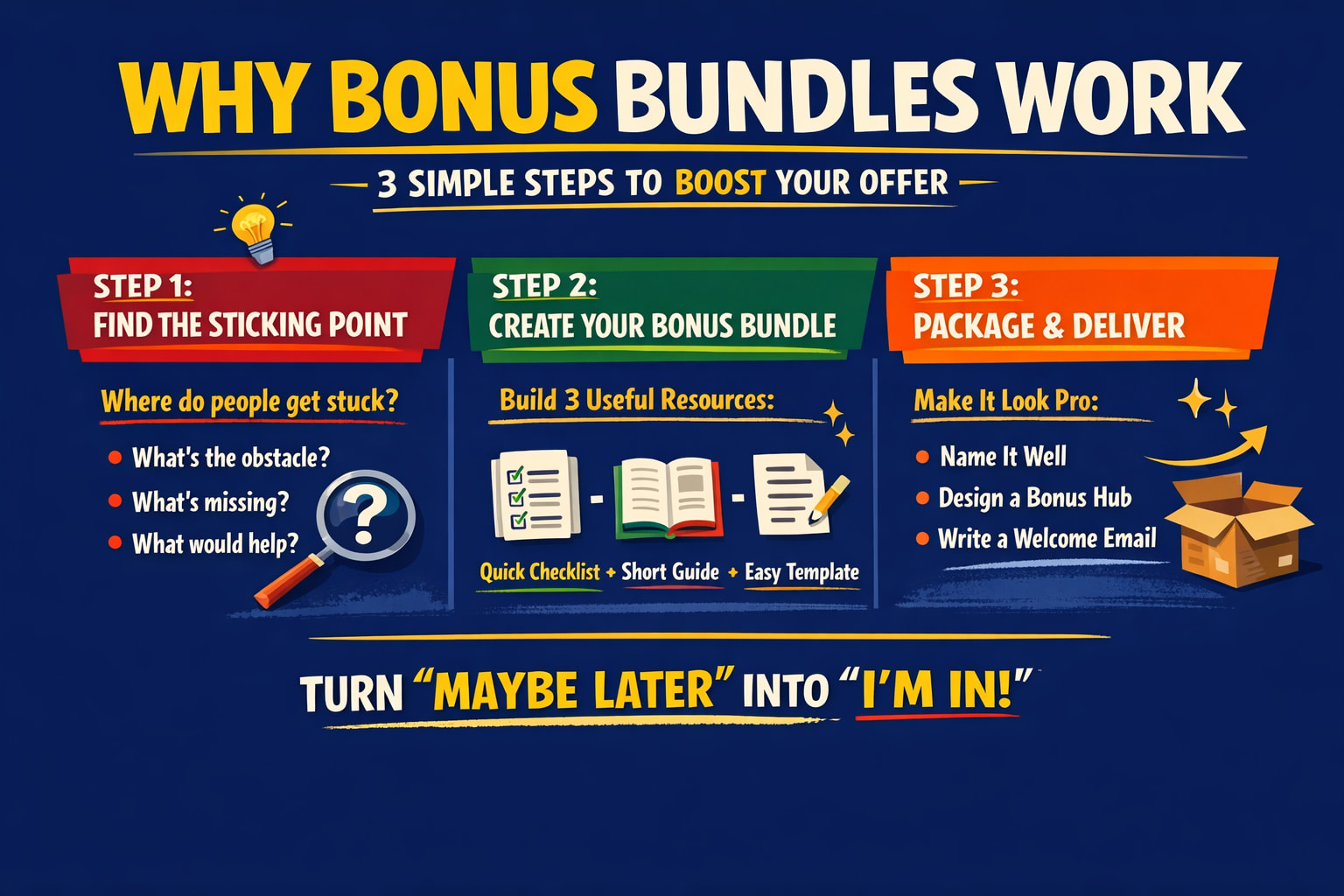
Step 1: Find the Sticking Point
Not the “what sounds impressive” point. The “where do people get stuck” point.
Ask yourself:
Where do buyers stall after they purchase?
What do they need to implement this faster?
What’s missing that would make the main product feel smoother?
Examples:
If you’re promoting an email marketing course, maybe it explains strategy, but doesn’t give swipe files or segmentation basics.
If you’re promoting a clean eating challenge, maybe the plan is solid, but people panic the second they have to eat out.
If you’re promoting a productivity program, maybe it’s inspiring, but people still do not know what to do on Monday morning.
Your bonus should be the bridge between “I bought it” and “I used it.”
Here are the three best bonus angles. Burn these into your brain:
Angle 1: Fill a gap in the product.
Angle 2: Add speed or simplicity to the result.
Angle 3: Tailor it to a specific audience segment.
Pick one. Or combine them into a bundle.
Step 2: Create One Implementation Booster. A Checklist
Why a checklist? Because it’s instantly usable. And usable beats impressive every time.
Here’s a prompt you can use:
“Create a one-page Quick Start checklist that complements a beginner productivity course. The checklist should help users implement the first week faster. Keep it simple, printable, and practical.”
And what you want back is something like:
“15-Minute Weekly Reset Checklist
Pick your top 3 priorities
Schedule 2 focus blocks
List your must-do tasks
Remove one distraction
Prep one thing for tomorrow.”
That’s it. No fluff. No life coaching.
Just a tool that makes action feel easy.
You take that, drop it into Google Docs or Canva, make it look clean, and suddenly you have a bonus that feels real.
Step 3: Add One Content-Based Bonus. A Short Guide
The trick with guides is to make them narrow. One problem. One outcome. Under 1,000 words. Step-by-step.
Prompt:
“Write a short guide under 1,000 words titled ‘How to Segment Your Email List Without Tech Headaches.’ This is for people who bought an email marketing course that didn’t cover segmentation basics. Keep it friendly and step-by-step.”
Why segmentation? Because it’s one of those boring-sounding things that quietly makes money. Segmented campaigns repeatedly show stronger performance than blasting the same message to everyone.
So your bonus guide becomes the missing puzzle piece.
Again, the goal is not to replace the main offer.
The goal is to make the main offer easier to use.
Step 4: Complete the Bundle with One Template
Templates reduce decision fatigue. That’s why people love them. They stop staring at a blank page.
Prompt:
“Create a fill-in-the-blank template my audience can use immediately. My audience is beginner solopreneurs who get overwhelmed writing their first funnel emails. Keep it simple and encouraging.”
You might get:
-
subject line formulas
-
a plug-and-play email opening structure
-
a basic 3-email sequence outline
Now you have your trio:
-
checklist
-
short guide
-
template
And if you’re thinking, “That’s too simple,” yes. That’s the point. Simple gets used.
Step 5: Package It Like a Grown-Up
This is where a lot of people trip. They create good bonuses, then deliver them like a ransom note.
Create a “bonus hub” page, even if it’s basic:
-
a Google Doc with links
-
a simple Notion page
-
a clean Drive folder with a cover page
Then ask AI for the copy:
“Write short descriptions and warm CTA copy for a 3-part bonus bundle that includes a swipe file, checklist, and template. Keep it clear, helpful, and confident.”
You’ll get blurbs you can paste into your delivery page so people instantly understand what each bonus does.
Step 6: Name It
Humans will judge your bundle by its name. This is unfair, but consistent.
Prompt:
“Give me 10 name ideas for a bonus bundle that enhances a [niche] product. Make it feel practical, valuable, and slightly exclusive.”
You’ll get options like:
-
The Fast-Track Toolkit
-
The Quick Win Bundle
-
The Simple Start Pack
-
The Momentum Vault
Pick one, make a simple cover graphic, and your bundle looks intentional.
Step 7: Write the Delivery Email
Because the delivery moment is a trust moment.
Prompt:
“Write an email that delivers the bonus bundle. Thank the buyer, remind them how the bundle helps them implement faster, and give clear download instructions. Keep it friendly and concise.”
In the email, include:
-
What is the bonus
-
Why it matters
-
What to do first
-
where to access everything
If you want to increase engagement, add one line like:
“Start with the checklist. It takes 15 minutes, and it sets up the rest.”
People love being told what to do first.
So Here’s Your Challenge
Pick a product you’ve already promoted or plan to promote.
Ask yourself: where do people get stuck?
Then use AI to create:
-
one checklist
-
one short guide
-
one template
Format them, name the bundle, and write a simple delivery email.
You will end up with a bonus bundle that increases perceived value, reduces hesitation, and makes you look like the person who didn’t just recommend a product… You made it easier to succeed with it.
And that’s how people learn to trust you.
Not with hype. With help.
If you enjoyed this article, save it, share it with someone who’s currently trying to sell things on the internet without losing their mind, and come back next time.