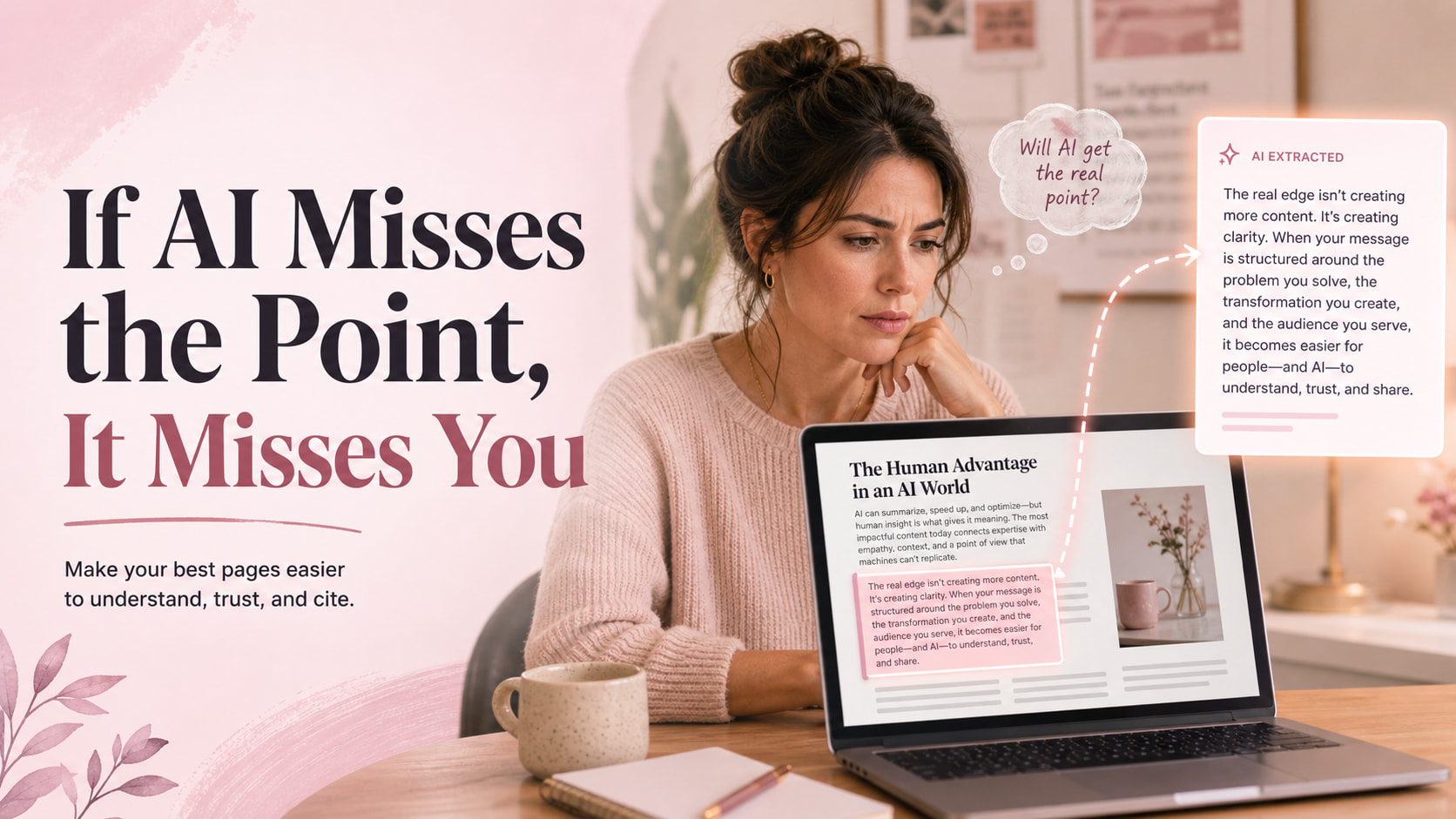
So, let’s start with a real page on your site. Not a theory. Not a content strategy diagram. Open one of the articles you’re proud of and ask yourself a slightly uncomfortable question: if an AI answer engine pulled only one paragraph from this page, would it understand what you meant?
I’ve seen this problem again and again. A page can be thoughtful, useful, and well-written for a human reader, but still fail as a source because the key answer is buried, softened, or spread across too much context. In this piece, you’ll learn how a Large Language Model (LLM) such as ChatGPT uses web pages as sources, why some strong content gets overlooked, and how to make your pages easier for AI systems to understand, trust, and cite.
Large language models don’t browse the web the way you do. They don’t click links, skim headlines, or scroll through pages looking for information. When an LLM uses your web page as a source, it processes the text as a flat stream of tokens. It extracts factual claims and structured information, then decides whether your content is worth citing.
That changes the job of a page.
Understanding this process changes how you write and structure your content. Pages designed for human browsing behaviour often fail when an LLM tries to extract useful information from them. The content might be great for a reader who scrolls and skims, but invisible to an AI that needs clean, self-contained statements it can confidently reuse.
Google’s own Search Central guidance makes the same broader point in a search context: structured data helps Google understand the content of a page and details such as people, books, companies, authors, and dates. That does not mean structured data alone makes content citable, because sadly, the machines still expect us to do actual writing, but it does show how much machine understanding depends on clarity and structure.
How LLMs Process Your Content During Retrieval
When a retrieval-augmented LLM like Perplexity or ChatGPT with browsing searches the web, it pulls chunks of text from your page and evaluates them for relevance to the user’s query. It doesn’t read your entire page like a human would. It grabs the sections most likely to contain the answer and works with those chunks in isolation.
This is the part many content creators miss. You may think your article works because the whole piece builds beautifully from one idea to the next. But an LLM may never see that graceful build. It may only see one extracted section, separated from the careful context around it like a quote dragged into a group chat with no explanation. A tiny digital crime, but here we are.
This means every section of your page needs to stand on its own. If a paragraph only makes sense in the context of three paragraphs above it, the LLM may pull that paragraph without the context and misrepresent your content. Self-contained sections with clear topic sentences are far more likely to be cited accurately.
Authoritative research on retrieval-augmented generation (RAG) supports this basic principle. RAG systems improve factual responses by giving language models external documents to work from, especially when information is dynamic, time-sensitive, or outside the model’s training data. But that only helps if the retrieved content is clear enough to use. A messy source gives the system messy evidence, and then everyone acts shocked when the answer comes out wearing odd socks.
LLMs also evaluate the confidence level of your claims. Hedged language like “some experts believe” or “it’s possible that” gets treated differently than definitive statements like “the recommended daily intake is 2,000 calories.” Clear, factual statements with specific details are easier for an LLM to extract and cite than vague or heavily qualified ones.
That doesn’t mean every sentence should sound absolute. It means your strongest facts need to be stated clearly enough to survive being lifted from the page.
What Makes a Page “Citable” for an LLM
A citable page has clear definitions, specific facts, and well-organised sections that an LLM can pull from without needing to rewrite or reinterpret. Think about it from the AI’s perspective: if it needs to answer “what is X,” it’s looking for a sentence that says “X is [clear definition].” If your page buries that definition in a story or spreads it across three paragraphs, the LLM will look elsewhere.
That is the sharper truth: good writing is not always good source material.
A page can be warm, clever, and persuasive, but if the answer is too implied, too delayed, or too dependent on surrounding paragraphs, it becomes harder for an AI system to use. That is frustrating, especially for writers who have spent years learning how to sound natural rather than robotic. Now the challenge is not to become robotic. It is to make the useful parts easier to identify.
Author and source credibility signals also matter. LLMs are trained to prefer content from authoritative sources. Pages with clear author attribution, visible credentials, and citations to primary sources are more likely to be selected over anonymous or unattributed content. Consistent factual accuracy across the site reinforces this preference.
This is where human trust and machine trust start to overlap. A reader wants to know who wrote the page and why they should believe it. An AI system also benefits from signals that help identify authorship, topic, source quality, and supporting evidence. Google’s article structured data guidance, for example, highlights details such as title, image, author, and date information as signals that help systems better understand a page.
Freshness and accuracy signals influence selection, too. Pages with recent update dates, current statistics, and up-to-date information are preferred over pages with stale data. If your page references statistics from 2019 while a competitor’s page has 2025 data, the LLM is more likely to cite the newer source.
Google’s guidance on page dates recommends showing update dates clearly when content has been significantly updated, and using datePublished and dateModified where relevant, so algorithms can recognise those dates more easily. That is not glamorous work. Neither is brushing your teeth, but apparently, both stop decay.
Quick-Win LLM Source Hack:
Pick your most important page and read through it, looking for any sentence that directly answers a common question about the topic. If you can’t find one clear, quotable sentence that an LLM could pull as a standalone answer, add one. Put it near the top of the section it belongs to and make it factual, specific, and self-contained.
This is a small change, but it can reveal a lot. You may realise your page explains the idea beautifully without ever stating the answer plainly. That is often where the gap sits: not in the quality of the thinking, but in the packaging of the claim.
A strong source page does not make the reader work too hard to find the point. It gives both humans and machines a clear handle to grab.
Your Immediate Next Steps
Open your five most important pages and read each section as if it were the only thing an LLM would see. Does each section contain at least one clear, factual statement that could be quoted independently? If any section requires reading three prior sections to understand, rewrite it to be self-contained.
Next, check whether your pages include clear definitions for the main concepts they discuss. If your page is about email marketing but never explicitly defines what email marketing is in a quotable sentence, add one. LLMs look for these definitional statements when they need to answer “what is” queries.
Finally, update any pages with outdated statistics or old data. Replace 2019 numbers with current data wherever possible. Add a visible “last updated” date to each page. LLMs that have access to freshness signals will prefer your content over competitors who haven’t refreshed their information.
The challenge is not to strip the personality out of your content. Please don’t. The internet is already beige enough.
The challenge is to make your strongest ideas easier to extract, verify, and cite. Because in AI search, being helpful is no longer enough if the useful part is hidden three paragraphs deep.