So, let me tell you about a shift most creators haven’t fully processed yet.
You publish a thoughtful article. You rank. You feel that small hit of validation.
Then you open your analytics.
Traffic is flatter than it should be.
Not gone. Not catastrophic. Just… lighter.
You tell yourself it’s competition. Seasonality. An algorithm mood swing.
But what if it’s something structural?
Today, we’re talking about what Google isn’t saying out loud about AI search.
And this isn’t a rant. It’s a strategy conversation.
The No-Click Reality
Picture this.
Someone types a question into Google. It’s the exact question you answered in depth on your site. You researched it. Structured it. Optimized it.
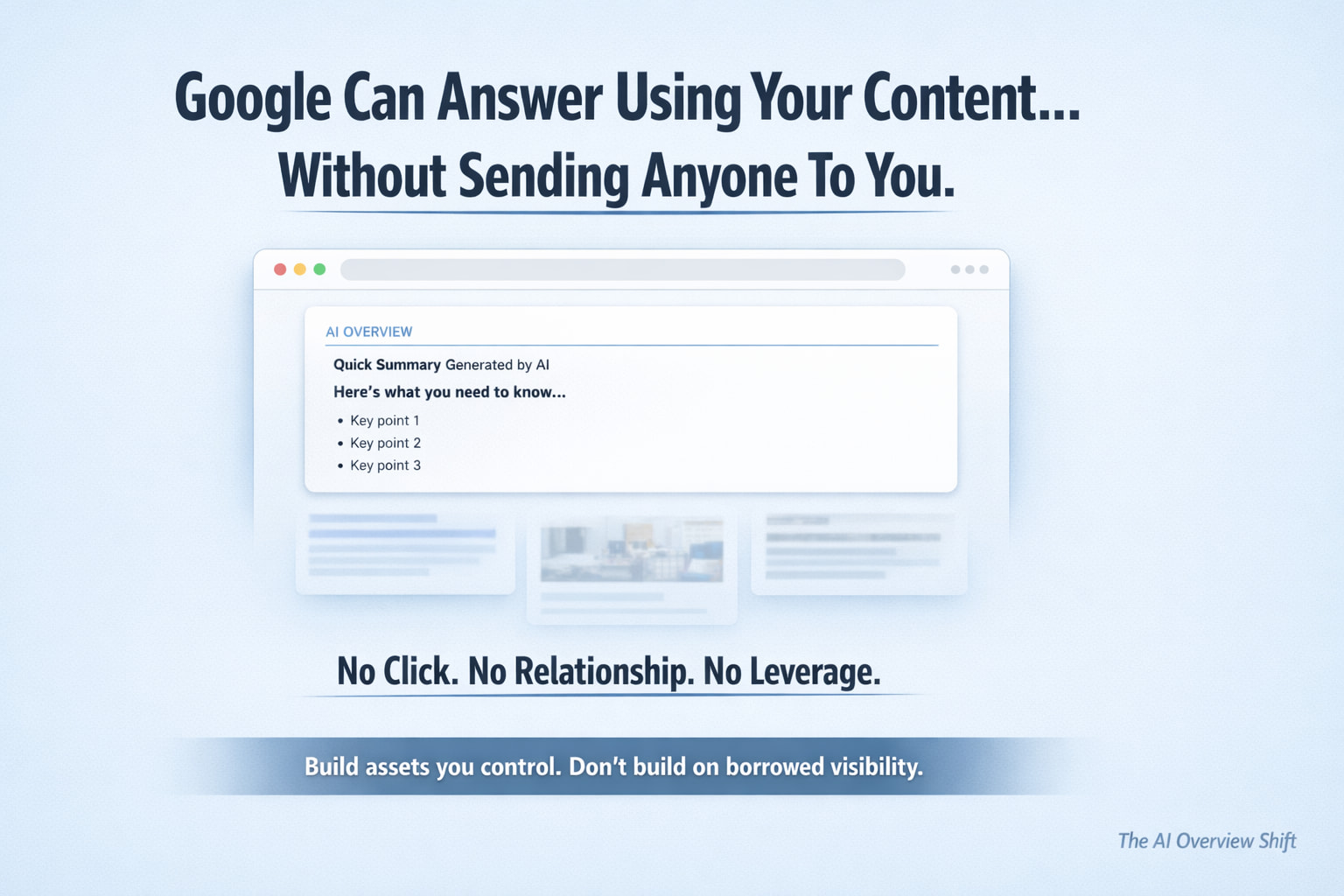
Google shows a polished AI summary at the top of the page.
They read it. They feel satisfied. They never click.
Now here’s the question that matters:
If Google can answer your audience’s questions using your content without ever sending them to you… Do you still own your business, or are you just feeding someone else’s product?
Let that sit for a second.
Because that’s the real shift.
When User Experience Reduces Creator Leverage
Google frames AI Overviews as a better user experience. Faster answers. Less friction.
From a user perspective, that’s true.
From a creator’s perspective, something else is happening.
You create the expertise. The platform distributes the answer.
The engagement stays with the platform.
So we have to ask:
At what point does “better user experience” quietly become “less creator leverage”?
That’s not anti-innovation. That’s understanding incentives.
Attribution Without Attention
Let’s talk about attribution. AI results may include links. But if users leave with a complete answer, they don’t need to explore further.
If they don’t click, they don’t remember the source.
If they don’t remember the source, they don’t remember you.
Visibility without engagement doesn’t build a business.
And here’s the strategic question:
If traffic becomes optional in the search experience, what exactly is your long-term growth plan built on?
That’s not dramatic. That’s math.
The Incentive Structure
Google makes more money when users stay inside Google.
AI answers support that goal beautifully.
The platform optimizes for retention.
Creators historically optimized for referral traffic.
Those incentives are not aligned anymore.
When incentives diverge, the system changes. Quietly at first.
The Bigger Strategy Shift
So what does this actually mean?
It means search traffic cannot be your only pillar.
It means direct relationships matter more than ever.
Email lists. Communities. Owned platforms.
Products and services that don’t rely entirely on borrowed traffic.
This isn’t about fighting AI search.
It’s about building something that survives regardless of it.
The Real Question
This article isn’t about whether Google is right or wrong.
It’s about understanding where power is concentrating.
Platforms optimize for keeping attention.
Creators need to optimize for staying in business.
So the real question is not:
“Is Google being unfair?”
The real question is:
Are you building something that can survive if search traffic keeps shrinking?
That’s not fear. That’s foresight. And foresight is what keeps creators independent.