Alright gang  - I just watched this YouTube chat from the ‘AI SEO Show’ with Mark Williams-Cook (AlsoAsked / Candour / Core Updates) and it felt like someone finally said the quiet part out loud … links + authority are still ruling the roost, and a lot of what he’s describing maps perfectly to how parasite SEO works in the real world.
Here’s my “reporting back” version, with the bits that made my ears perk up.
What really hit home: “SEO hasn’t changed much in 20 years”… until now
Mark’s take is basically:
-
For years we’ve all said “SEO is changing”
-
But it’s mostly been the same recipe: website + content + links
-
The actual paradigm shift now is user behaviour moving across channels (Google, YouTube, ChatGPT, Perplexity etc.)
Guess what? … That’s exactly what most parasite SEO methods have been quietly doing all along, even if they didn’t realise it!
You’re not “ranking a website” anymore, you’re positioning yourself inside the properties that get cited / surfaced.
“DISCO baby!”
The parasite SEO alignment (this is the spicy bit)
Mark talks about looking at iGaming SERPs because that’s where you see the algorithm’s “cracks”.
He mentions results packed with parasite-hosted pages beating legit brands, and he gives a proper grim example:
-
an old school website with loads of trusted links (even .gov style authority signals)
-
homepage repurposed into gambling content
-
still had the rest of the site indexed as the old topic
-
and it ranked for a huge amount of casino keywords until it got clocked
Now… I’m not saying anyone should go replicating dodgy hacks on hijacked domains (don’t be that guy; think ‘expired domains’ instead  ).
).
But the principle is the same one we use in parasite SEO, just without the criminal energy:
 Authority of host domain matters massively
Google still leans on site trust as a shortcut
That shortcut can be exploited (white/grey/black hat depending how you do it)
If you’ve ever watched a mediocre page rank purely because it lives on a monster domain… you’ll recognise the pattern immediately.
The Helpful Content Update test that made me laugh/cry
This was one of the most useful “proof” moments:
-
One of his hobby sites got absolutely nuked (like 99% traffic loss)
-
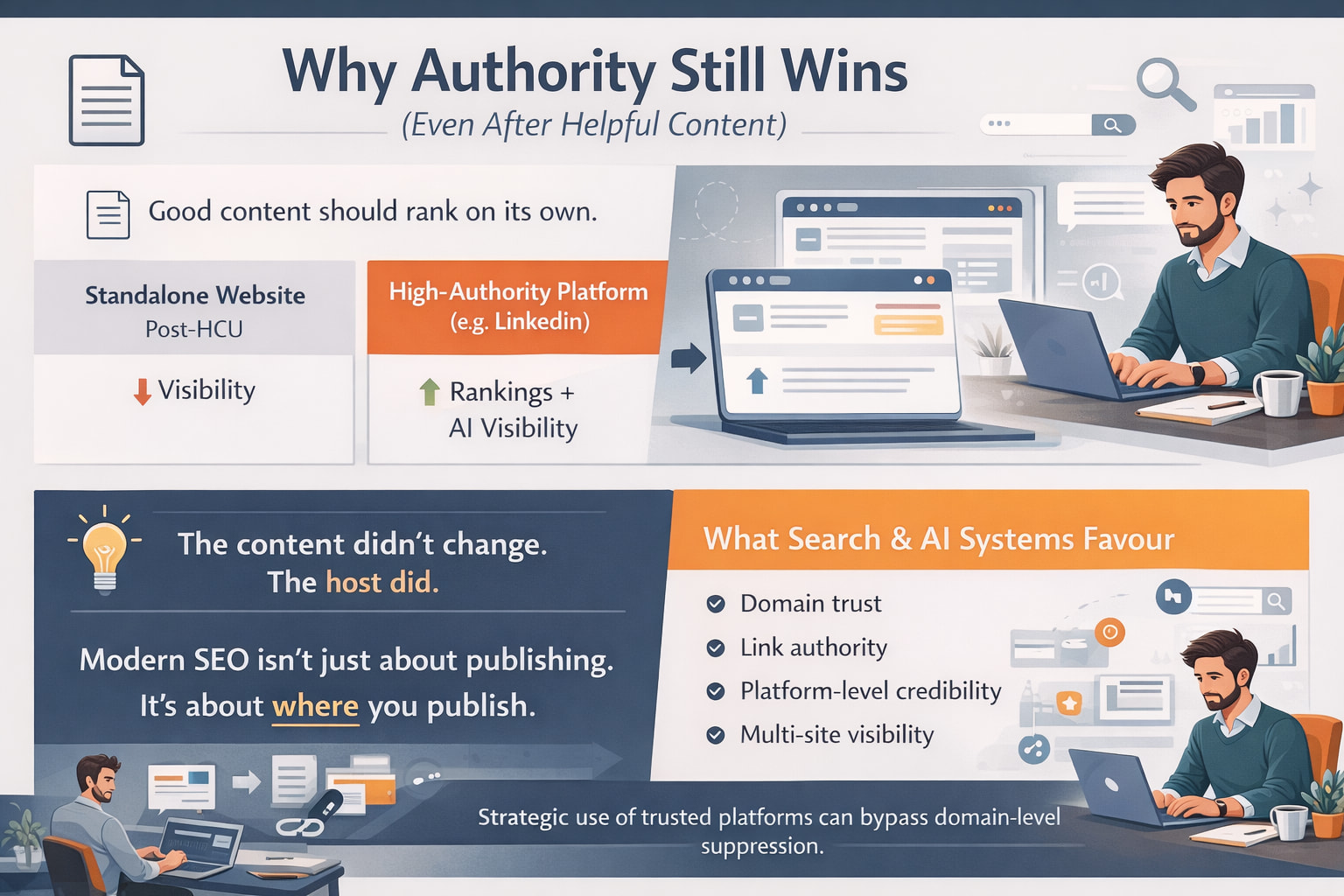
He copy/pasted the same content onto LinkedIn Pulse
-
48 hours later it ranked top / featured snippet / AI surfaces
(I’d like to know what happened to his conversions though!)
So the takeaway wasn’t “the content was bad” - it was basically:
Google was suppressing the site, not the words.
That is… painfully consistent with what we see when we publish similar content on high-authority platforms and it suddenly behaves like it’s been blessed by the SEO gods.
Parasite SEO is literally a workaround for this reality.
Brand + LLMs: “Your brand becomes what the model believes”
He goes a step further and says we’re heading into:
-
Brand used to be what you told people (old school ads)
-
Then it became what people say online (reviews, Reddit, forums)
-
Next it becomes what LLMs think your brand is
Which again … makes parasite logic even more relevant.
Because if the LLM is pulling sources from top results, then the game is:
-
show up on your site
-
but also show up across other sites that rank for the same topic
That’s parasite SEO in a suit and tie.
I know … I know, I’m obsessed with parasite SEO!
People Also Ask gold mine: stop treating it like “FAQ stuffing”
This was a great reminder:
Most people use PAA like:
“Here are 20 questions, let’s paste them at the bottom and answer them.”
Mark’s angle is smarter:
-
PAA reveals intent + emotion
-
Example he gave: Revolut PAA is basically “is my money safe?” → users are anxious → homepage needs trust proof, not more keyword blocks
When you start seeing PAA like this, it’s more like intent psychology in plain sight !
Also: he says PAA updates ridiculously fast (hours during news cycles). That’s useful if you’re running parasite pages on trending topics and want to keep your angle aligned to what people actually care about this week.
My two pence …
I’ve been banging on in here for ages that parasite SEO isn’t some “cute hack”… it’s a response to Google’s trust bias and it always has. Ever since Google created ‘Page Rank’.
Mark basically confirms:
-
links still matter
-
host authority still matters
-
algorithm is still patchy in competitive verticals
-
and AI hasn’t removed the need for information retrieval… it’s just changed how people consume the output
So yeah, I’m more convinced than ever that parasite is still one of the cleanest ways to get wins without waiting 12 months for a new domain to earn trust.
If you want to actually do something with this
If you’ve been lurking and thinking “I should probably try parasite SEO properly”… now’s the moment.
I posted about my free parasite SEO guide the other day:
-
using the Coda platform to build parasite topical clusters
- (think PAA)
-
how I structure pages to actually rank (and not just exist)
-
how I think about authority + internal linking on parasite hosts
-
how to avoid the common rookie mistakes that get you nowhere
You can grab it here, courtesy of the DMC crew.
And for discussion: what’s the most blatant example you’ve seen of “authority beating quality” in the SERPs lately? (bonus points if you say what I’m thinking … lol)