So, most people treat subject lines like a last-minute detail. They write the email, then slap on the first line that comes to mind and hit send. Then they wonder why open rates stay stubbornly low.
The subject line is the gatekeeper. If it doesn’t spark interest, the rest of the email never gets a chance. You can write the best content or offer in the world, but if no one clicks, it dies quietly in the inbox.
And here’s the uncomfortable question: if you won’t test the one line that decides whether your email gets read, are you really serious about results?
Why AI Makes Subject Lines Easier to Improve
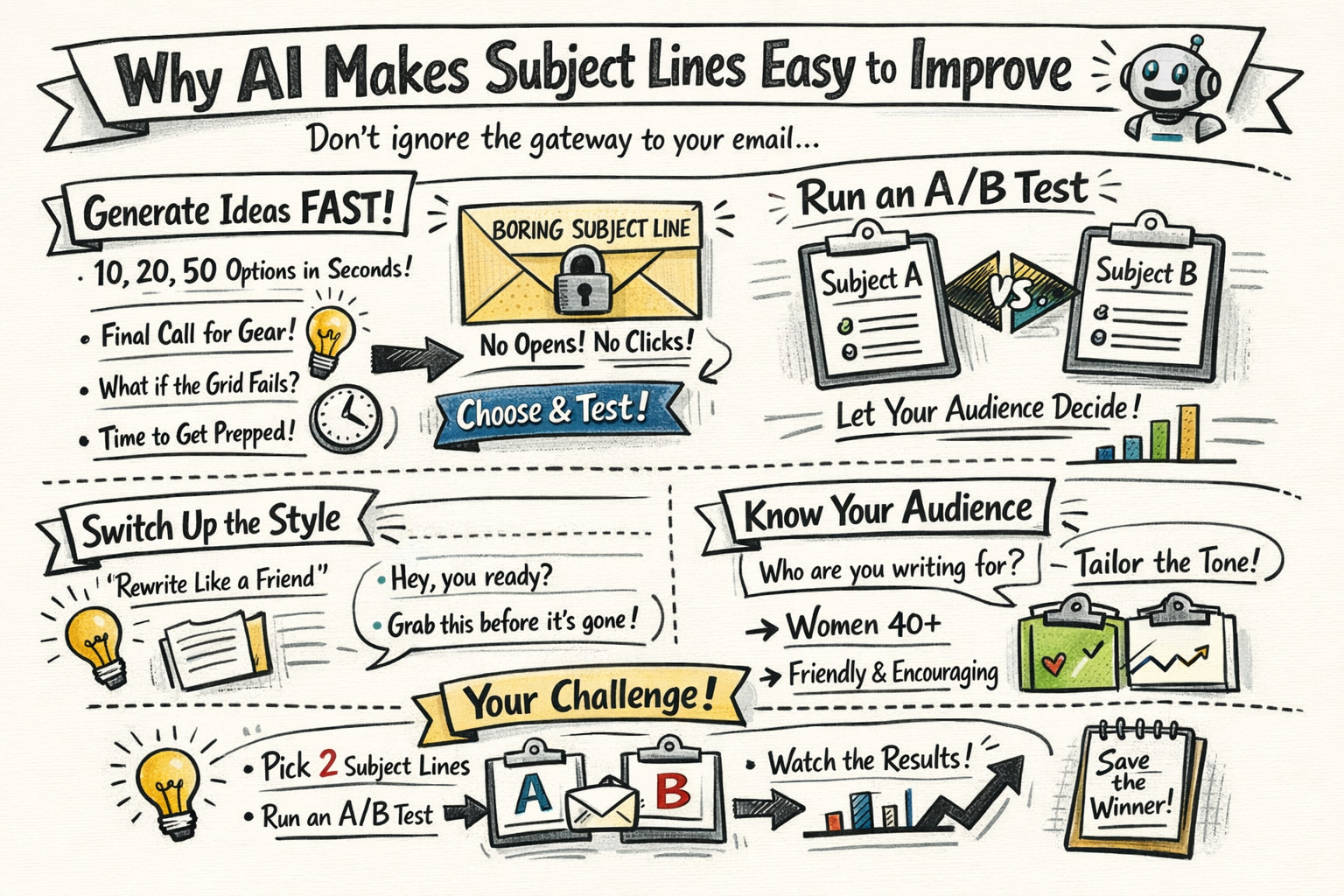
AI helps because it removes guesswork and replaces it with options. Instead of writing one subject line and hoping it works, you can generate 10, 20, or 50 variations in seconds. You can ask for different tones, lengths, levels of curiosity, or urgency. You can also give clear boundaries so the suggestions stay on-brand, not spammy.
Once you have a strong set of options, you choose two that are clearly different and run a split test. That’s where the real learning happens, because the audience decides what works, not your mood on a Tuesday.
A Simple A/B Workflow You Can Run Every Week
Let’s say you’re sending an email about a flash sale on a digital survival gear bundle. Paste the email into ChatGPT and use a prompt like this:
“Write 10 subject lines for this email that use urgency and curiosity. Avoid spam trigger words. Keep each one under 50 characters.”
You’ll get a spread of angles, for example:
-
Clock’s ticking: get your gear
-
You’ve got 24 hours to prep
-
Final call: survival tools inside
-
What if the grid failed tomorrow?
At this point, you might have a gut feeling about which ones stand out, but the test is what tells you what performs.
Then you can shift tone completely, without rewriting the whole email. Ask:
“Now rewrite these in a conversational tone, like a text from a friend.”
You might get:
-
You good if things go south?
-
Hey, don’t sleep on this deal
-
Just in case, grab this
-
Prep like tomorrow’s chaos
Now you have two distinct styles to test. One may win on curiosity. The other may win on trust. Either way, you’re not winging it.
You can also improve what you already wrote instead of starting from scratch. For example:
-
“Give me five alternatives that are more curiosity-driven.”
-
“Rewrite this with more urgency.”
-
“Make this less salesy but still persuasive.”
That approach is often faster and keeps your messaging consistent.
Make the Output Fit Your Audience
AI gets dramatically better when you tell it who you’re talking to. If you don’t, you risk getting generic clickbait that sounds like every bad marketing email ever sent.
Try adding context like this:
“My audience is women over 40 who are tired of restrictive diets but still want to lose weight. Make the subject lines friendly and encouraging, not hyped up or dramatic.”
Then give it a specific task:
“Write 10 email subject lines about a new free guide to portion control for women over 40. Focus on ease, confidence, and small daily changes.”
That tends to produce more usable results, such as:
-
Finally, a plan that isn’t extreme
-
Portion control without the pressure
-
Small steps. Big changes.
-
What if you didn’t feel deprived?
Now pick two subject lines that differ clearly in angle, then test them. You learn fast what this audience responds to, and you stop relying on guesswork.
You can also use AI after the campaign goes out. If an email underperformed, ask:
This subject line got a 12% open rate. Why might it have underperformed? Rewrite it to improve curiosity and clarity without sounding spammy.
That feedback loop helps you avoid repeating the same mistakes and improves your instincts over time.
When you find a winner, reuse the structure, not the exact words. If a curiosity question outperforms a statement, test more question-based formats. If short, blunt lines beat longer ones, keep exploring that pattern. Over time, you build a bank of subject line templates that suit your list, and you stop burning energy reinventing the wheel.
One caution: don’t over-rely on AI. It can generate clever lines all day, but it doesn’t know your subscribers’ behaviour. Use the tool to brainstorm. Use split tests to decide. Your gut will have opinions. Your metrics will have answers.
Your Challenge
Choose one email you’re sending this week. Paste the full body into ChatGPT and use this prompt:
“Write 10 subject lines using urgency and curiosity. Keep them under 50 characters.”
Pick two favourites that sound meaningfully different from each other, then set up an A/B split test in your email platform. If you don’t have that option, send two versions to two comparable segments and track open rates manually.
Watch the results for a few days. Save the winner and add it to a swipe file. Then do it again next time. Each test sharpens your messaging and raises your open rates, without adding more work to your actual emails.