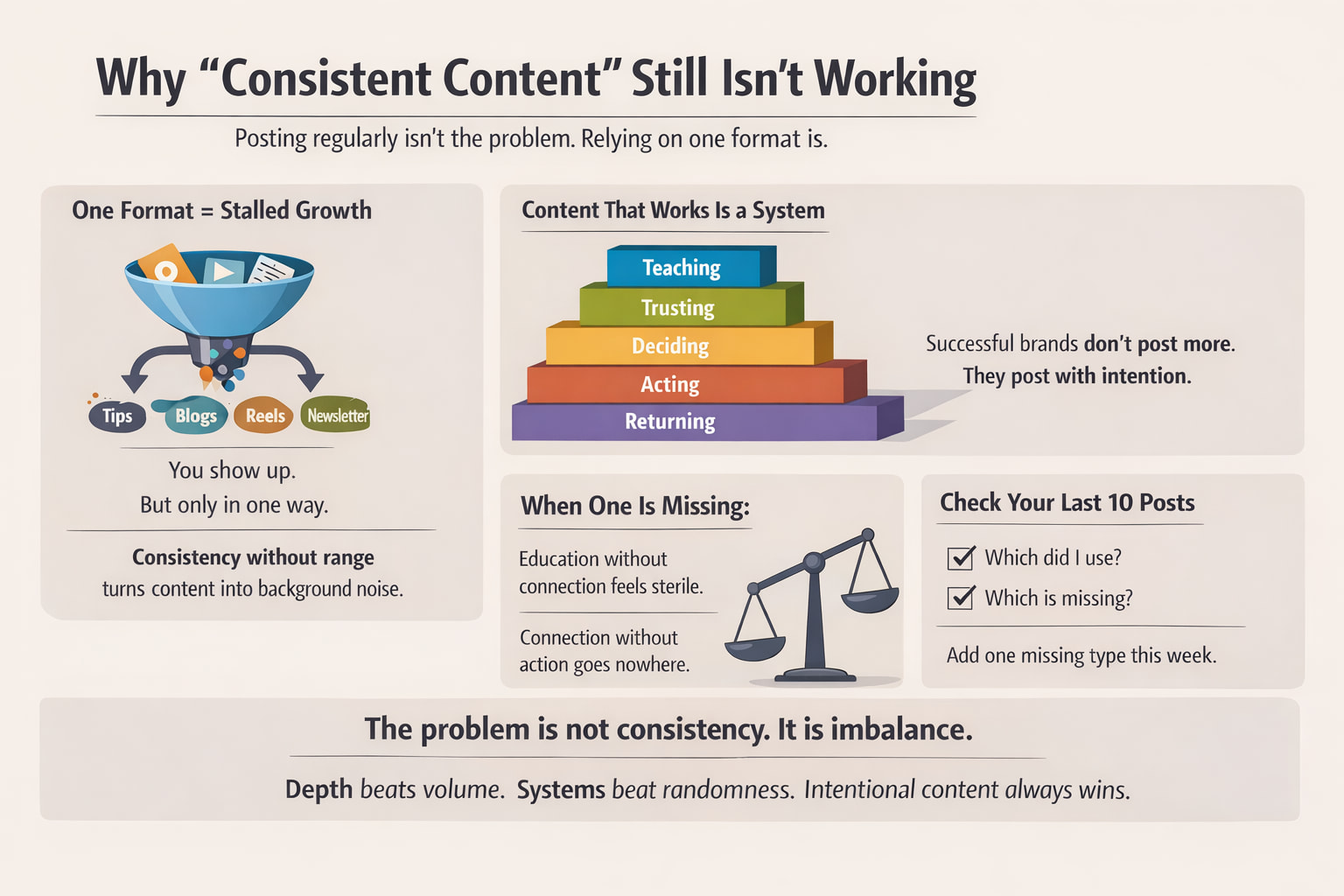
So, when most people think about content creation, they default to one or two familiar formats. Maybe you’re regularly posting quick tips on Instagram. Maybe you send the occasional newsletter.
Maybe you’ve published a few blogs that explain a concept or two. But even if you’re consistent, your content might still be falling flat, not because you’re not showing up, but because you’re only showing up one way.
When One Format Becomes a Bottleneck
The online businesses that grow consistently don’t rely on a single type of content. They employ a mix of different tones, formats, and levels of depth that work together to serve various purposes.
The goal isn’t to overwhelm yourself by being everywhere or producing more. It’s to ensure you’re covering the right types of messages that resonate with your audience in different mindsets.
If you’ve ever felt like your content is solid but your results are shaky, it might be because you’re missing one of these five foundational types of content. You don’t need to be on every platform.
You don’t need to publish every day. But you do need to be strategic with what you create. When you blend these five, your content starts working like a system instead of a string of disconnected posts.
Why Consistency Isn’t the Whole Story
The first type of content you need is educational. This is the one most people are comfortable with. It’s the how-to, the listicle, the mini tutorial, the breakdown.
Educational content gives your audience quick wins. It teaches them something they didn’t know or explains something they didn’t fully understand. This kind of content builds authority. It shows you know your stuff and you’re generous enough to share it.
The risk with educational content is that it can become a default. If it’s all you post, your audience might learn something, but they won’t necessarily connect with you or feel moved to act. That’s why it can’t stand alone.
The second is connection content. This is what builds rapport. It’s where you show your personality, your values, your stories. It’s often casual, sometimes vulnerable, sometimes funny.
It gives people a sense of who you are behind the brand. You might be talking about a recent win, a lesson learned, a client success, or a moment of struggle that helped shape your perspective.
Connection content doesn’t sell directly, but it deepens trust. People don’t just buy information; they buy from people they like, respect, and resonate with. Without this layer, your content can start to feel robotic, even if it’s helpful.
The third type is belief-shifting content. This is where you challenge assumptions, flip the script, and reframe common ideas. It’s where you take a stand, even if it goes against what’s popular.
This kind of content positions you as someone who thinks differently, someone who offers a new way to approach a problem. It helps your audience question what they’ve been doing and opens them up to new possibilities.
Belief-shifting content is powerful because it helps people decide that change is possible. It sets the stage for them to want your solution, without you ever needing to pitch. Most people skip this type entirely, but it’s one of the most influential things you can create.
Next, you need action-driving content. This is the piece where you get specific about what you want someone to do. It might be a clear call to subscribe, register, purchase, or book a call.
This is the content that makes the invitation. And if you’ve earned enough trust, it’s the content that converts. Too many creators shy away from this one. They don’t want to seem pushy, so they stay in give-give-give mode forever.
But if you never tell people what to do next, you’re creating confusion. Action-driving content doesn’t need to be aggressive. It just needs to be clear. You’re not forcing people. You’re guiding them. And if your other content types are in place, this one feels natural, not salesy.
Finally, there’s re-engagement content. This one gets ignored the most, and it’s one of the most important. Re-engagement content is designed to bring people back in. These are the posts, emails, or videos that revive interest from people who’ve gone cold.
Maybe they downloaded a freebie but never bought. Maybe they followed you months ago and haven’t engaged since. Maybe they clicked around your site but left without taking action.
Re-engagement content speaks to that hesitation. It reminds people of what they were curious about. It revisits old pain points or goals. It tells stories about others who took the next step and got results. And it creates momentum for those who were interested once but never followed through.
When you weave all five types of content into your brand consistently, you start to create balance. You’re not just teaching, you’re building trust. You’re not just selling, you’re shifting beliefs.
You’re not just showing up, you’re reconnecting with people who were already halfway there. Each type plays a role. And when one is missing, your content starts leaning too hard in one direction.
Too much educational content without connection feels sterile. Too much connection content without action leads to popularity without profit. Too much belief-shifting content without education can come across as opinion without substance. Too much sales content without the other layers creates pressure. And if you never re-engage people who drifted, you miss out on the audience you already earned.
How to Audit Your Content and Fix the Missing Piece
The key isn’t balance in every post. It’s a balance across your body of work. Look back at your last ten pieces of content. Are you hitting all five types? Or are you stuck in a loop of tips, reels, or stories that aren’t actually moving people forward?
You don’t need to reinvent your entire strategy today. Start by identifying what’s missing. Then challenge yourself to create one piece of content this week that fills that gap. Maybe it’s a belief-shifting blog post.
Maybe it’s a re-engagement email. Maybe it’s a story-driven Instagram post that builds a connection. You’ll notice that your audience responds differently when your content starts speaking to more than just their curiosity. It speaks to their decision-making. Their doubts. Their goals. And that’s when the shift happens.
If you’ve been putting in the effort but not seeing the payoff, the problem might not be your consistency. It might be your diversity. Add depth to your strategy, not by doing more, but by doing what you’re already doing more intentionally. The results always follow.