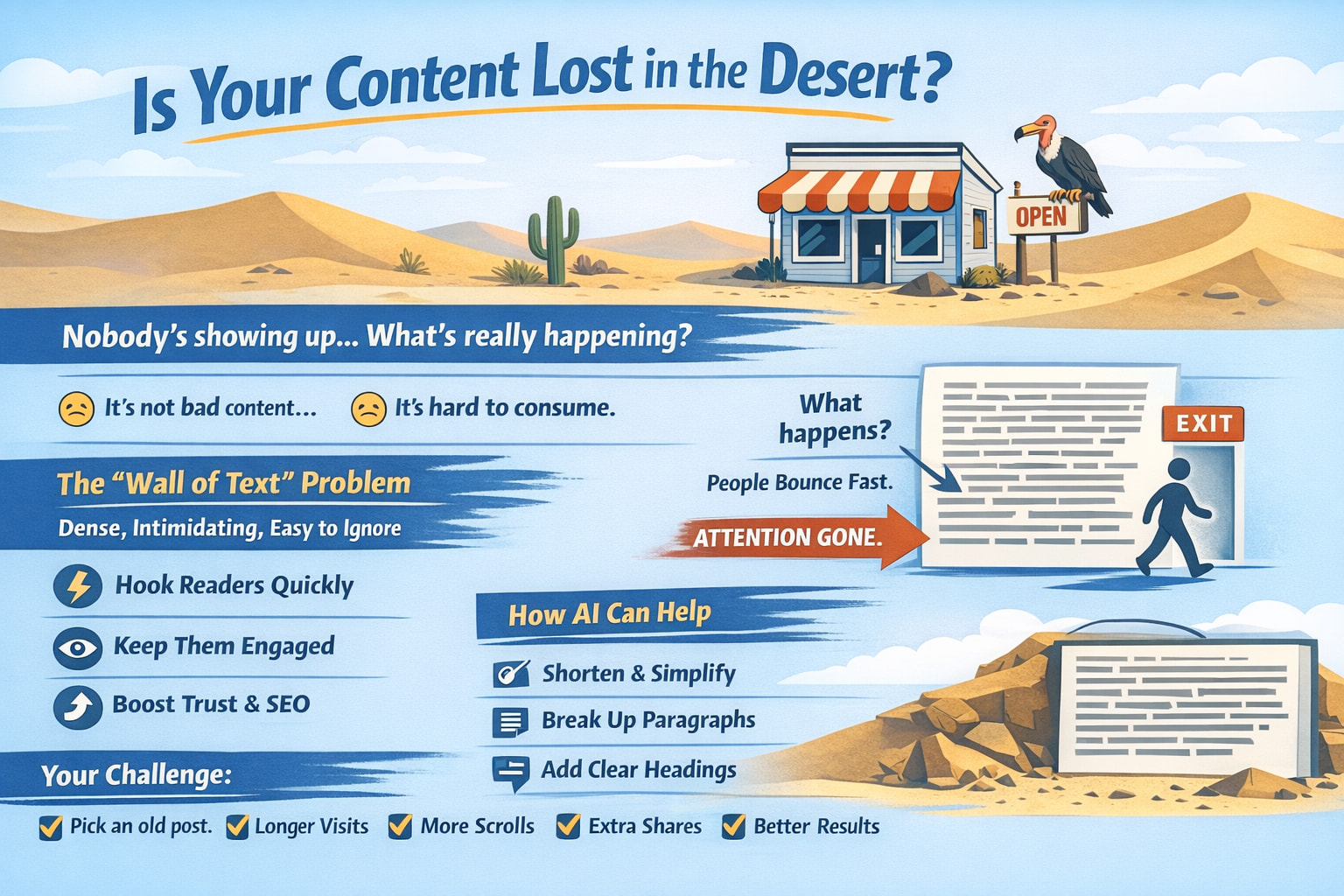
So, did you ever publish a blog post you’re genuinely proud of… only for it just to sit there? No traffic. No momentum. No meaningful change. Like you built a beautiful shop in the middle of a desert and expected customers to politely appear.
I want to start with a moment most people don’t admit.
It’s that quiet little experience of checking your analytics… and realizing your content is not being rejected because it’s “bad.”
It’s being ignored because it’s hard to consume.
And in today’s SEO, hard to consume is the fastest way to disappear.
Today we’re talking about readability. Not because it’s a nice writing habit, but because it’s one of the most reliable ways to keep readers on the page, earn trust faster, and increase the odds your content gets surfaced in the places that matter, including AI-powered search experiences.
And yes, we’re going to use AI. Not to churn out lifeless posts. To rescue solid ideas from a messy presentation.
The New Reality
Here’s the truth that makes people uncomfortable.
SEO is no longer just about ranking. It’s about retention.
Because if someone lands on your page and bounces, the system learns something. It learns that your result didn’t satisfy the intent.
And now we have another layer: search engines increasingly summarize answers right in the results. So even if you rank, you might not get the click.
That means your content has to do two jobs:
First, it has to earn attention instantly.
Second, it has to keep attention once it’s earned.
And readability sits right in the middle of both.
Let me paint you a picture.
You’re searching for something practical.
Maybe: “How to store emergency food at home.”
You click the first result.
And you’re hit with a wall of text.
Not a helpful guide. A block.
A paragraph that looks like it wants to fight you.
What do you do? You leave.
Not because you hate the author.
Not because you don’t care about the topic.
Because your brain took one glance and decided: “This is going to cost effort.”
And effort is the one thing people refuse to spend online unless they absolutely have to.
The “Wall of Text” Problem
I worked with someone a while back who had a really solid blog. Smart content. Great niche. Useful topics.
But the posts weren’t performing.
When we looked closer, the problem wasn’t their expertise. It wasn’t their keyword research. It wasn’t their topic selection.
It was the reading experience.
They wrote the way many professionals write when they’re trying to sound credible.
Long sentences. Dense paragraphs. Lots of “when considering” and “it is important to take into account…”
And it wasn’t wrong. It was just exhausting.
So we took one paragraph and ran a simple readability rewrite with AI.
Same meaning. Half the words.
And suddenly the post felt like it had airflow.
And here’s the surprising part: they didn’t lose authority.
They gained it.
Because clarity reads like confidence.
Confusion reads like insecurity, even when the writer knows what they’re doing.
A Quick Example (Before/After)
Let me give you a quick example. Here’s a classic sentence:
“When considering your food storage plan, it’s important to take into account the types of food you’ll be storing, the shelf life of each item, and the climate conditions of the space…”
That sentence isn’t evil. It’s just… a lot.
Here’s the rewrite:
“Before you store emergency food, think about what you’re storing, how long it lasts, and where you’ll keep it. Heat and moisture shorten shelf life quickly. The right storage space makes a real difference.”
Same information. Clearer structure. Easier to scan.
And scanning matters because people don’t read online like they read books.
They skim first.
Then they decide if you deserve their full attention.
Your writing has to pass the “skim test” before it earns the “read test.”
Why AI Helps (Without Killing Your Voice)
Now, if you’re thinking, “Fine, I’ll rewrite everything myself,” I respect the ambition.
But most people do not have time to rewrite a library of content line by line.
This is where AI actually shines, when you use it like an editor instead of a ghostwriter.
AI is good at:
Shortening sentences without changing meaning
Breaking paragraphs into readable chunks
Creating clean subheadings
Removing repeated phrases
Smoothing awkward transitions
Adding sections readers expect: quick takeaways, FAQs, step-by-step formatting
And the key detail is this: you can keep your voice.
You don’t have to sound like a template.
You just have to tell the AI what your voice is.
Professional. Direct. Warm but not fluffy. Whatever your brand is.
Because the goal isn’t to become “AI content.”
The goal is to become more readable.
The Practical Framework (What to Prompt)
Let’s get practical. If you want AI to improve readability and SEO, start with this core prompt:
“Rewrite this blog post to improve readability and SEO. Use shorter sentences, tighter paragraphs, and clear subheadings. Keep the tone: [insert tone]. Include the keyword [insert keyword] naturally.”
That’s the base. Then you can layer in what modern readers expect:
Add “Key Takeaways” near the top.
Add a short FAQ at the end.
Surface the answer early, then expand.
Here’s another prompt that works well for scannability:
“Rewrite this post to improve scannability. Break long paragraphs into 2–3 sentence chunks. Add short subheadings every 150 to 250 words. Highlight key phrases naturally.”
And if your writing tends to sound formal or stiff:
“Rewrite this so it feels more human and clear, like a professional explaining it plainly. Remove corporate phrasing and improve transitions.”
That one alone can transform content that reads like a policy document into something people actually finish.
The Hidden SEO Benefit (Trust + Extractability)
Here’s what’s sneaky about readability. It doesn’t just keep humans reading.
It makes your content easier for search systems to understand and extract.
And that matters more now because content gets reused in summaries, snippets, and AI-driven results.
Clear headings. Clean definitions. Short answers. Simple structure.
That’s not “dumbing down.”
That’s respecting how information is consumed.
And it can also support credibility.
When you write clearly, you come across as more trustworthy.
When you add practical steps and acknowledge limitations, you sound like someone who knows what they’re doing.
In the attention economy, trust isn’t built by sounding fancy.
It’s built by being useful quickly.
Let me end with a small challenge.
Pick one underperforming post. Just one.
Not the one you hate. The one you believe in, but it’s not getting the results.
Paste it into ChatGPT and use a readability prompt. Keep your voice. Add scannable structure. Tighten the intro. Clean up the conclusion.
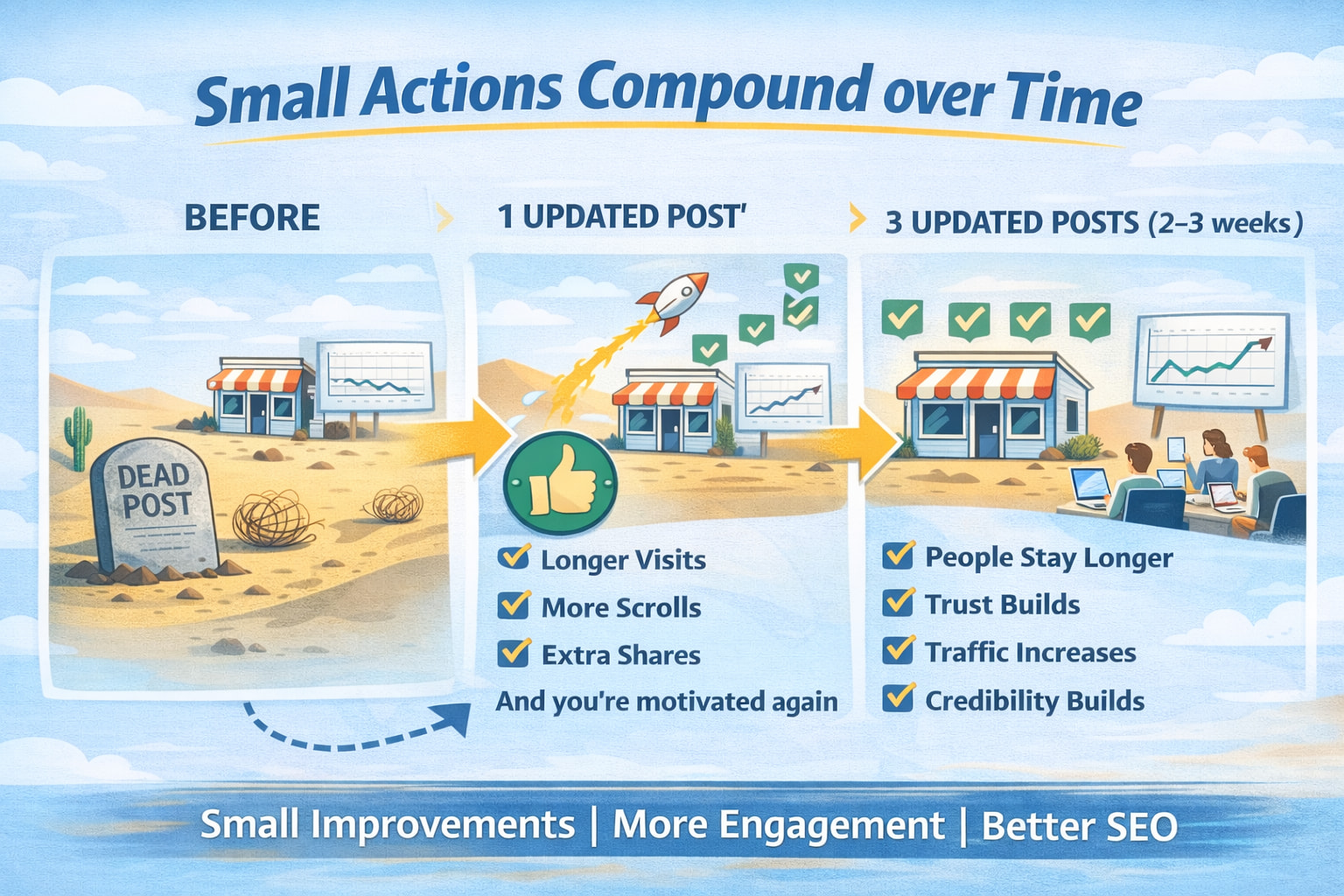
Then publish the updated version.
And instead of obsessing over rankings tomorrow, watch what happens over the next couple of weeks:
Do people stay longer?
Do they scroll further?
Do they click to another page?
Do you get more saves, shares, or comments?
Because better readability does more than “help SEO.”
It increases the number of people who actually receive your message.
And that’s the part most people forget.
It’s not just about getting seen. It’s about being read.
That’s it for today. If you want a fast workflow, rewrite one post per day for a week. Tighten the structure. Keep it human. Track the changes.
Your best ideas deserve better formatting than a wall of text.
Talk soon.