Most people say they’re doing local SEO.
What they usually mean is they installed a theme, added a logo, and started fiddling with headings like Google is grading their homework.
That’s not a system … it’s more like window dressing.
Before touching the Google Business Profile (GBP), I needed something that actually existed online. Not a ten page monument to optimism. Just something real enough to anchor the entity.
So I used the Namecheap AI site builder and thankfully, it didn’t summon Skynet.
I fed it the service idea, let it spit out a structure, then rewrote the copy so it sounded like a human who lives in the town rather than a brochure from 2009.
About an hour later I had a site that looked legit. Clean and focused. No superfluous nonsense.
Was it custom coded? Absolutely not. Did it need to be? I’ll let you answer that one 
Once that was live, I kind of forgot about it for a while and returned to the project a couple of months later … then the real game began.
Category Is Leverage. Get It Wrong and You’re Shadowboxing.
Your primary GBP category is not decorative. It is the room you are choosing to fight in.
Pick a broad one and you’re competing with everyone and their nan. Pick a tight one and suddenly the competition shrinks but the intent sharpens.
Local authority is not about being seen across a super wide area. It is about being trusted within a few miles of your location first.
Most people want to “rank the whole town” but you’re better off focusing within maybe a 5 x 5 mile area before you consider spreading your wings.
Obviously, in a very small town that area might cover most of your customer base.
Service Area Is Strategy, Not Admin
People treat the GBP service areas like it’s paperwork. Add a few postcodes, tick a box. Done.
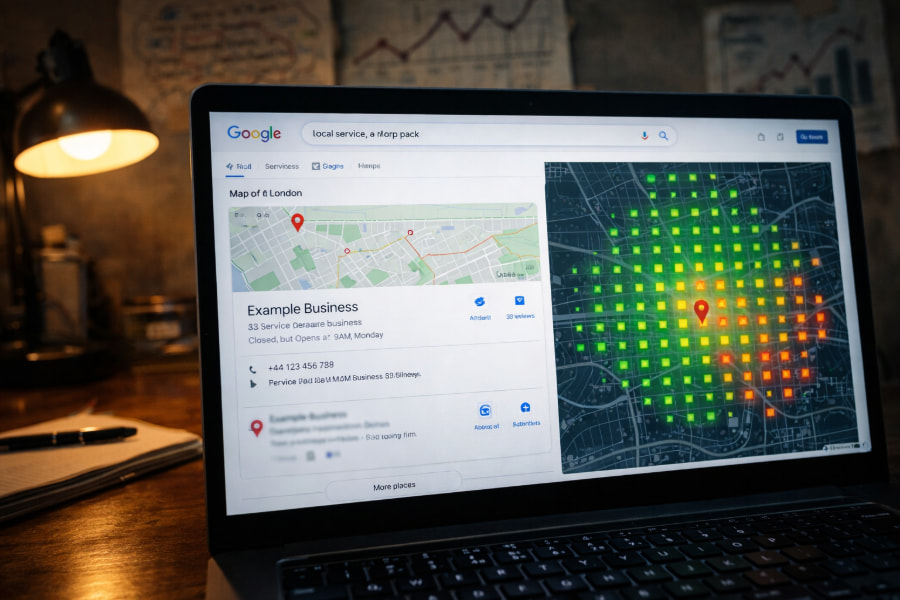
But proximity behaves differently depending on density and competition strength. So I ran grid scans early to establish the shape of the battlefield.
The town centre was competitive but not too long after setting up the GBP, my exact match domain was already sitting pretty at #1 in the map pack for the core keyword.
Nice
So I already had a strong gravitational centre and the project became more about building out and letting it expand.
If you try to rank everywhere immediately, you look weak everywhere.
Alignment of Website with GBP Beats Hustling Later on
Here’s where I might annoy a few people.
- You do not need to post daily.
- You do not need 200 citations.
- You do not need a backlink spreadsheet that looks like a crypto portfolio.
You need alignment.
- Homepage mirrors primary category.
- Language reflects actual service intent.
- Location references are specific without sounding desperate.
Then the GBP mirrors that exact framing. You end up with consistent emphasis. Same tone and same core service angle.
Your website supports the GBP … the GBP validates your website.
You might feel that loop is boring but it is also very effective.
One Page First. Earn the Right to Expand.
SEO Jesus was banging on about one page sites.
Strip away the launch energy and there’s a solid principle underneath it.
Stay focused … So I kept it tight.
I built the bare bones. A homepage. Clear service offer. Local relevance. No “resources” section pretending to be helpful. No blog posts about industry trends that nobody in the town has ever searched for.
The obligatory ‘About us’, ‘Contact’ and ‘Terms/Privacy’ pages are something ChatGPT can create very easily … Namecheap’s AI, even easier!
Once I had my baseline grid visibility established and I let things settle for a week or two, then I added supporting pages. Properly aligned service pages, 600 to 800 words, each reinforcing the same entity.
A small expansion of content came after establishing that stability.
… and I have done little else with the website since.
When It Started Acting Like a System
After tightening category alignment and reinforcing the homepage properly, Google immediately stood up and took note.
For the primary target keyword, the grid was already 99% green for my service area … without any off-page SEO (we’ll get to that later in the series).
It has been rock solid at #1 (occasionally #2) in the map pack for almost the entire time I’ve been paying this little project any attention.
The foundation is stable and I can actually test things without guessing.
- Photo updates.
- Post cadence.
- Minor category tweaks.
- Citation layering.
I can see which small changes produce measurable movement.
… and the best bit? It’s already producing highly targeted, genuine local leads. Some have even converted
This is working really well so far.
In the next post, I’ll get into where and how SEO Neo fits in to all this … this is where things get interesting and I have some real results to share with you all.
We’ll look more closely at grid scan patterns and local signals that move the needle.
Because once you see how the map behaves, you stop chasing rankings and start engineering them.
Thanks for reading!
-Rohan