In the previous post I talked about how the project was put together. A simple site, tightly aligned with the Google Business Profile, and no unnecessary content bloat.
Nice and tidy.
But theory is cheap.
What matters is what Google actually decides to do with your listing once it’s out in the wild and this is where Google Maps grid scans become very useful.

I’ve been running them using SEO Neo since early January so we can see how the map has behaved over time. I’m not revealing the keyword or the niche, for obvious reasons, but honestly the niche isn’t the interesting part anyway.
What matters is how the signals move the needle.
Local search behaves very differently from normal SEO. Rankings don’t just climb gradually up a list.
They behave more like gravity.
Get the centre strong enough and the rest of the map slowly starts orbiting around it, with the correct signal sequence …
So let’s start with the earliest scan.
The Starting Point
This first scan was taken on January 13th.
At that point the GBP had only recently been created and the website, whilst aged a couple of months, was still about as sophisticated as a rusty biscuit tin. No link campaigns had been run yet and the project was mostly just sitting there quietly while Google worked out what it was looking at.
Here’s what the grid looked like.
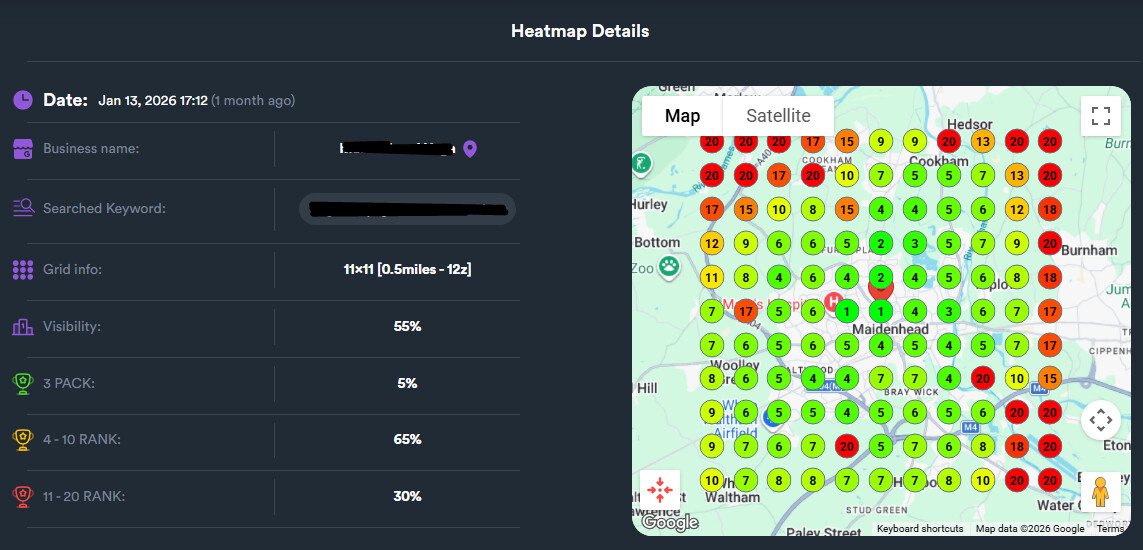
A couple of things jump out straight away.
First, the centre of town is already looking pretty healthy. Several top three positions in the map pack clustered right around the business location.
That’s exactly what you want to see.
Google almost always tests a new listing closest to the physical location first. If the entity signals are clean and the category makes sense, it tends to give you a bit of breathing room in that immediate area.
Think of it as Google saying … “Alright then, let’s see what you can do”
This strong start was almost all due to the exact match domain name (thanks SEO Jesus!).
Outside the centre things look a bit more chaotic.
You’ve got greens and yellows scattered around the grid, but also quite a few reds toward the edges. Some positions are drifting around the mid teens and occasionally touching the twenties.
Nothing dramatic.
Completely normal.
A brand new local listing rarely turns an entire town green overnight unless the competition has completely fallen asleep. What you’re really looking for in an early grid scan isn’t dominance.
You’re looking for a stable centre of gravity.
If the middle holds, the rest of the map usually follows later.
If the centre is weak, you’re basically shadowboxing and hoping for the best. Luckily in this case the centre looked promising right from the start.
Which meant the next step was simply letting the system settle and watching how the grid evolved.
A Few Weeks Later
The next scan was taken on February 1st, a couple of weeks after the first one.
By this point the project had quietly moved into the next phase.
Shortly after the first scan I started a DAS campaign with SEO Neo. That stands for Domain Authority Stacking, which is essentially the pillowing phase of the link profile.
The idea is fairly simple.
Before you start throwing anchor text around later on, you publish a large base layer of raw URL links. Nothing fancy. Just the naked URL repeated across a stack of decent platforms.
It looks very natural to Google and it creates a sort of cushion around the site.
Later on when you start adding more aggressive links, that cushion helps absorb the impact so the profile doesn’t look over-optimised.
At least that’s the theory.
In this case it seemed to work like gangbusters.
I don’t mind admitting I was really paranoid about running the DAS on a relatively new domain with almost no authority yet. I thought Google might penalise the domain for an unnatural link profile. I’d been following Neo users on the private Discord and most advised it was nothing to be concerned about.
… seems they were right!
Some of the DAS links were pushed through Omega Indexer as well, which is another tool from the Stealth Code crew. The goal there is simply to make sure the links actually get discovered instead of sitting quietly in a corner of the internet forever.
By the time this second grid scan was taken, that whole phase had already had a couple of weeks to settle.
Here’s what the map looked like.
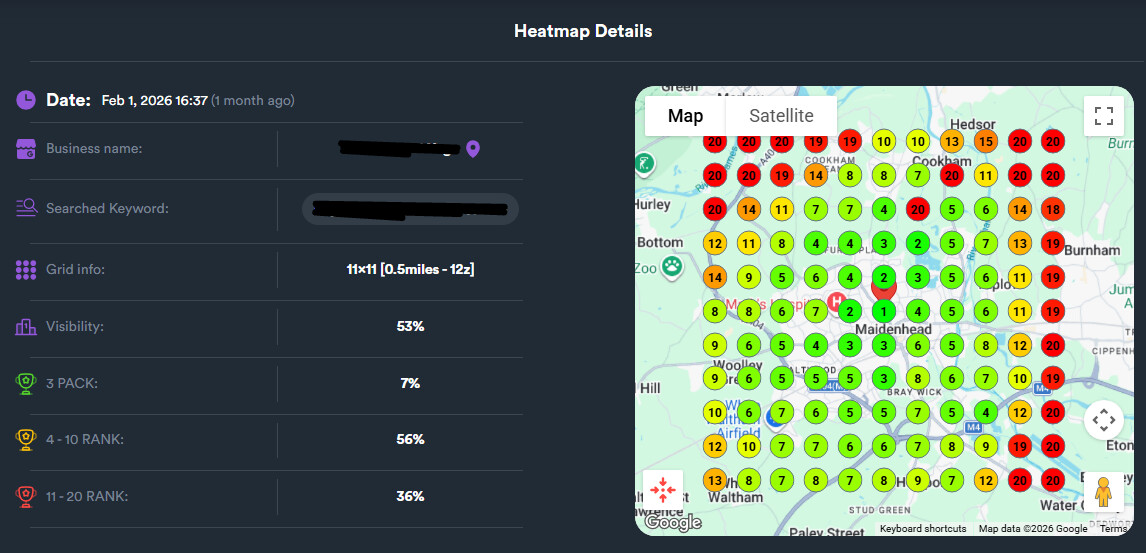
The first thing to notice is the centre of the grid has clearly strengthened.
Those top positions around the business location are now much more consistent and the immediate area is starting to turn properly green.
That’s exactly the behaviour you want.
Once Google starts trusting the entity signals, it tends to reinforce that central cluster rather than constantly retesting it. Outside that area things are still a bit mixed.
You can see yellows and reds toward the edges of the grid, particularly further out from the town centre. Some spots are still drifting around the mid teens.
Nothing unusual there.
Local authority usually spreads outward gradually rather than appearing everywhere at once. What matters here is the middle … and the middle is clearly getting stronger.
When the Grid Really Starts Turning Green
Fast forward another few weeks and the difference becomes much more obvious.
This scan was taken on February 23rd.
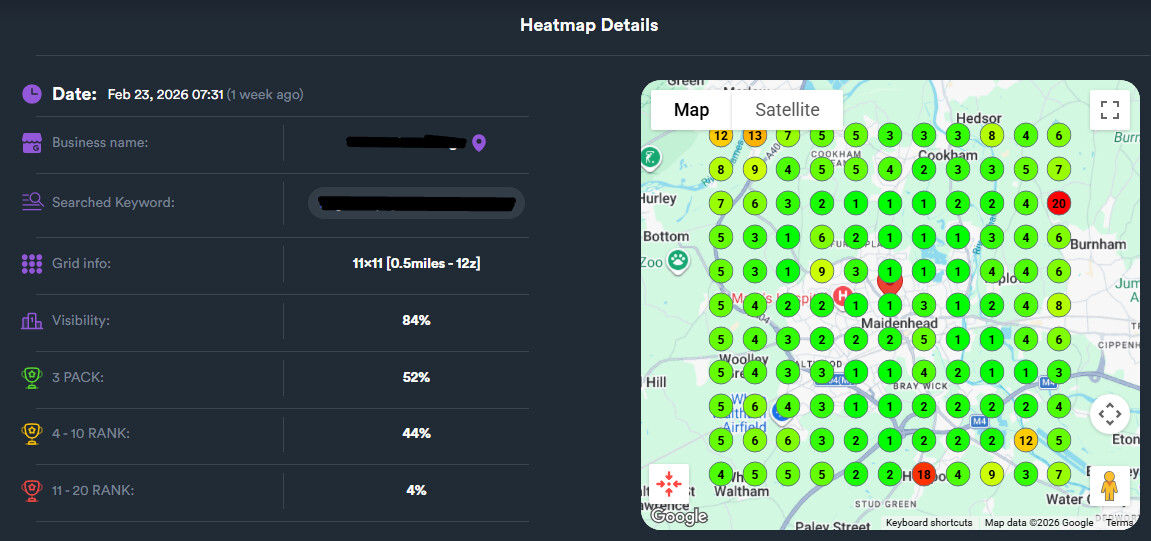
Now the grid looks completely different.
The centre is almost entirely green and the top three positions cover a much larger chunk of the service area.
Visibility jumped to 84%, with more than half of the grid now sitting inside the map pack.
That’s a pretty serious shift compared with the earlier scans.
The outer edges are still a bit patchy in places, which is normal for local search, but the core of the town is now firmly under control.
And that’s the important bit.
Lock the centre in with the EMD, expand using off-page local SEO.
Google has already decided the entity makes sense for that category and location, so the algorithm becomes far less cautious about showing it further out.
Around this same period the organic rankings started reacting as well.
The site briefly hit #1 organically for the core keyword and has mostly been hovering somewhere in the top few positions since.
Which is not bad going for a website that started life as a one hour experiment with an AI site builder.
Not exactly Silicon Valley engineering.
More like organised mischief.
Organic Rankings Start Getting Interesting
Alongside the grid scans I’ve also been logging the organic rankings twice a day for the core keyword.
The movement is quite interesting.
Early on the site was mostly bouncing around between positions 8 and 25. Pretty typical behaviour for a brand new local site while Google decides where it belongs.
Then the DAS campaign kicked in.
That was the raw URL pillowing phase I mentioned earlier. A large base layer of naked links designed to make the profile look natural before any heavier link signals are added later.
Within a few days the organic ranking jumped sharply.
Position 2, then briefly #1, then a bit of volatility as Google tested the waters.
Exactly the sort of behaviour you’d expect when a new site suddenly gets a strong signal injection.
After that I ran a few small batches of tier 1 Web 2.0 links through Omega. Nothing huge, just ten to fifteen URLs at a time. Google has been indexing between 40 - 80% of the links.
That phase helped stabilise things around the top three positions for a while. So we’re dominating the map pack and often in the top 3 of Google at this stage.

Organic still bouncing around a bit, which is perfectly normal, but the site was clearly being taken much more seriously at that point. High-intent leads started coming in more frequently.
Then I started playing with something slightly different.
The Wiki Stack and the GBP Direction Signals
Around the beginning of February I built a small wiki stack.
The idea here isn’t traditional link juice.
It’s geo-entity reinforcement.
Each page in the stack references various locations, the service, and links out to the Google Maps listing, the social profiles and AI links. That helps Google connect the entity signals more tightly around the location itself.
What I noticed after this phase is that the outer edges of the grid started improving.
Not instantly, but steadily.
Which makes sense.
If Google becomes more confident about the entity’s geographic relevance, the coverage area tends to widen.
After that came one of the more interesting experiments.
The GBP Blast.
This is a feature inside SEO Neo that generates thousands of Google Maps direction URLs pointing back to the listing.
Essentially it creates links from many different geographic coordinates asking Google Maps for directions to the business.
From Google’s perspective it looks like lots of people from different areas are trying to find their way to that location.
Which is actually quite a clever signal when you think about it.
Not too long after that campaign completed, the organic rankings started reacting again. There was some short term volatility, which is expected whenever you push new signals into the system, but the map pack position barely moved at all.
It has mostly stayed #1, occasionally dropping to #2 for short periods before popping back up again.
Which brings us back to the main point of this whole little experiment.
Once the centre of gravity is established, the rest of the system becomes much easier to influence. The listing already has local trust, so additional signals tend to amplify rather than destabilise it.
And the best bit?
The project is generating more and more genuine local enquiries.
A few of those have converted into paying customers as well.
Not bad for something that started life as a one hour AI website and a slightly mischievous SEO experiment.
So that’s about it for this little mini-series. I hope you enjoyed. Maybe it will inspire you to have a go at Local SEO!
Let me know your thoughts in the replies below.
Thanks for reading
-Rohan