So, here we are, the finish line is in sight! You should now have a well-researched, well-written, professional digital product, ready to sell! Here’s a link to the previous lesson, if you missed it:
Now, we just need to convince people to buy. Let’s go!
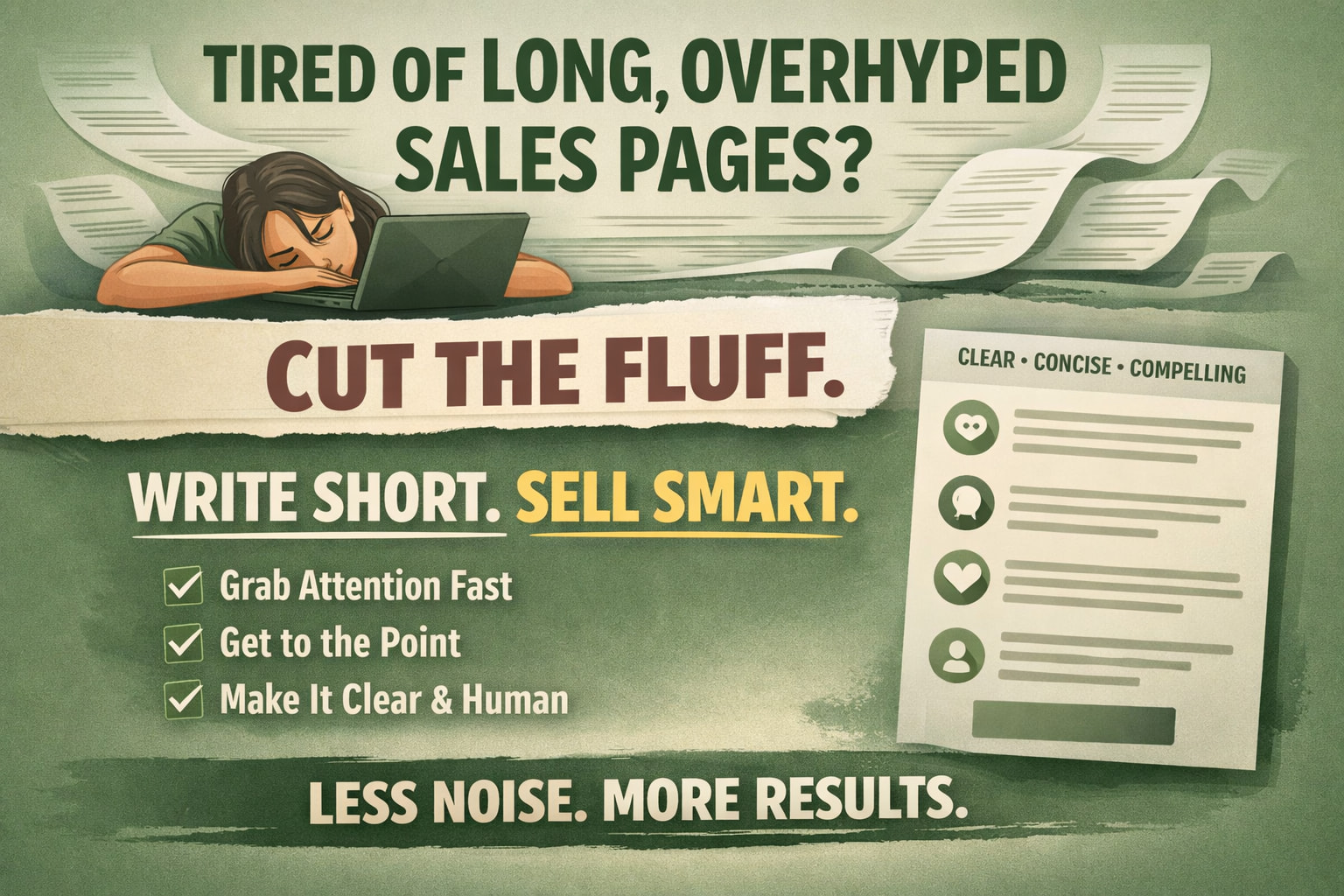
Have you ever landed on a sales page and felt tired before you even reached the middle?
You start reading, and within seconds, it is all huge promises, dramatic language, and endless scrolling. Somewhere in that wall of copy is probably a decent offer, but by then, you are already halfway out the door.
That is the problem.
A lot of people still believe a sales page has to be long to be persuasive. They think more words mean more value, more emotion, more selling power. But often, the opposite is true. A long, overworked sales page can feel less convincing, not more. It starts to sound like the writer is trying too hard to make the offer seem valuable, instead of simply showing why it is.
And buyers notice that.
Today’s buyers are quick. They scan. They skim. They make decisions fast. They do not want a performance. They want clarity. They want to know what this is, who it is for, and whether it solves a real problem for them.
That is why short, clear, confident copy works so well.
Not because it is trendy. Not because attention spans are doomed and everyone is allegedly turning into a goldfish. But because a clear copy respects the buyer. It gets to the point. It sounds human. And it makes it easier for someone to say yes.
So, if you have been staring at your sales page thinking it needs more words, more persuasion, more polish, this might be the shift you need.
Let’s walk through a simpler way to build one.
Step One: Write the Core Sales Page
Start with the full draft.
Not the perfect draft. Not the final draft. Just the core version that gives the page its shape.
Think of it like building the frame of a house. Before you start choosing cushions and lighting and all the decorative nonsense people get distracted by, you need the structure.
Your sales page needs to do a few simple things. It needs to open with the problem. It needs to highlight the insight, the thing most people miss. It needs to introduce the product clearly, explain what it promises, show what is inside, and then close with a simple invitation to buy.
That is it.
Here is the prompt:
“Write a short, direct sales page for this product: [PRODUCT NAME + ONE-LINE DESCRIPTION]. Tone: confident, friendly, and human. Structure it like this: open with the problem (2-3 sentences max), twist with the insight (what most people miss), introduce the product and its promise, list 6-8 specific things they get inside, add a short ‘this is for you if…’ section, and close with a simple call to action. Use short paragraphs throughout. No hype words. No ‘revolutionary’, ‘game-changing’, or ‘once in a lifetime.’ Just real, clear language.”
Once you have that, you are not done. You have the skeleton. Now you need to make sure the opening actually earns attention.
Step Two: Sharpen the Opening
The first few lines matter more than almost anything else on the page.
Because if the opening is weak, vague, or forgettable, most people will never reach your best points. They are gone before you even get a chance.
This is where many sales pages lose people. They open too softly. Or too dramatically. Or with generic claims that could belong to literally any product on the internet.
A stronger opening creates tension. It makes the reader feel something. Recognition. Curiosity. Even discomfort, sometimes. It gives them a reason to keep going.
So instead of settling for your first version, generate a few different opening angles and test which one hits hardest.
Use this:
“Write 5 alternative opening paragraphs for this sales page. Each should take a different angle: (1) a relatable frustration, (2) a surprising truth, (3) a blunt statement, (4) a short story setup, (5) a direct question. Keep each to 2-3 sentences max.”
Pick the one that feels strongest.
And once the opening is working, the next place to tighten things up is the bullet points.
Step Three: Write Better Bullet Points
This is where a lot of sales pages quietly fall apart.
Bullet points should be one of the easiest ways to build desire, but instead, many of them are flat, vague, and full of empty features.
People do not buy bullet points because they include a workbook, a checklist, or a set of templates. They buy because they understand what those things will help them do.
That difference matters.
A feature tells me what is included. A strong bullet tells me why I should care.
So your job here is to turn bland information into useful, outcome-driven detail.
Use this prompt:
“Rewrite these bullet points so each one is specific, benefit-driven, and creates curiosity. Instead of describing features, show the reader what they’ll be able to do, avoid, or achieve. Format each as: [What they get] - [Why it matters or what it unlocks]. Here are the current bullets: [PASTE THEM IN]”
This is where your sales page starts to feel more alive. More practical. More convincing.
And once that is done, there is one final step that too many people skip.
Step Four: Read It Out Loud
Read the whole thing out loud.
Seriously.
Because this is where you catch the weird stuff. The stiff phrases. The awkward transitions. The lines that looked fine on screen but sound completely unnatural when spoken.
If you stumble over a sentence, your reader will probably trip over it too. If a section sounds robotic, overly polished, or slightly absurd, fix it.
The goal is not to sound like a copywriter showing off. The goal is to sound like a real person who understands the product and can explain it clearly.
That is the standard.
Your sales page should feel like a confident recommendation from someone who knows what they are talking about, not a desperate speech trying to force the sale.
Closing
So, here is the takeaway.
You do not need a giant sales page stuffed with hype to sell a good product. You need a clear structure, a strong opening, sharper bullet points, and language that sounds like a real human being wrote it.
That is what makes short-form sales copy work.
It respects the buyer’s time. It keeps the message focused. And it gives your offer room to stand on its own without burying it under layers of noise.
If your sales page has been feeling clunky, overlong, or strangely lifeless, strip it back. Tighten it up. Make it clearer. Make it sound human.
Because sometimes the fastest way to sell something is not to say more.
It is time to finally stop saying what does not matter.
I hope you enjoyed this series! If you need any help, let me know!